Categories
Business

Wall St edges up with earnings, rate-cut expectations in focus

By Johann M Cherian and Ankika Biswas

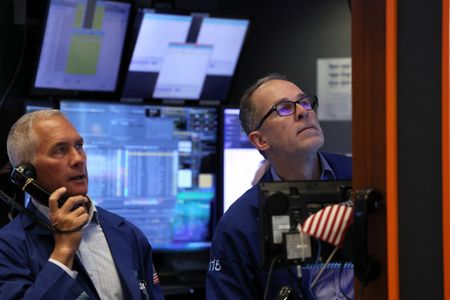
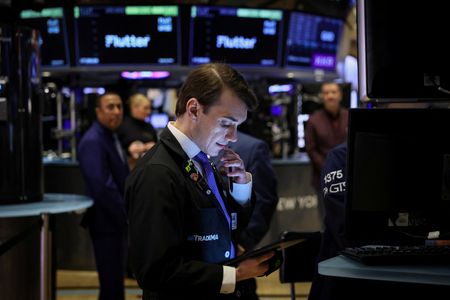
(Reuters) – Wall Street’s main indexes inched higher on Tuesday as investors parsed big-ticket earnings and awaited commentary from policymakers for clues on the timing of the Federal Reserve’s first interest-rate cut.

Eli Lilly jumped 3.5% after forecasting 2024 profit above estimates, driven by demand for its blockbuster weight-loss drug Zepbound and diabetes medicine Mounjaro.

GE HealthCare Technologies gained 8.0% after the medtech firm posted better-than-expected fourth-quarter earnings.

The S&P 500 healthcare sector was up 0.6%, scaling a record high. The materials index gained 1.4%, as chemicals firm DuPont de Nemours jumped 6% after beating fourth-quarter profit estimates, announcing a new $1 billion share-repurchase program and hiking its dividend.

With around half of the S&P 500 companies having reported earnings, 80.4% have surpassed expectations, according to LSEG data last week. Overall S&P 500 earnings are now expected to have risen 7.8% in the fourth quarter from the year-ago quarter.

Investors are actively monitoring forecasts from businesses against a backdrop of high borrowing costs and persistent slowdown concerns.

“Companies are telling us they see growth in six months to a year out and it could be growth in earnings or in the top line. But it’s definitely growth, and it’s not the recession that people were looking for last year,” said Kim Forrest, chief investment officer at Bokeh Capital Partners.

“Certainly there have been winners and losers in certain categories, but overall, we’re getting an economy that’s growing.”

Wall Street started the week on a glum note in the previous session on the heels of a blistering rally in the S&P 500, which notched 13 weekly gains out of 14. The benchmark index was aided by largely positive corporate earnings and optimism that a rate cut might be imminent.

However, Fed officials, including Chair Jerome Powell, have actively talked down market expectations of a quick start to policy easing, a key theme in the central bank’s interest-rate decision last week. Strong labor market and economic activity data have also fed into rate-cut anxieties.

Remarks from the Fed’s policymakers through the day, including voting member Cleveland’s Loretta Mester, will be on investors’ watch list.

Traders are betting with a nearly 65% chance that at least a 25-basis-point rate cut could be delivered in May, with the odds standing at around 94% for the first cut in June, according to the CME FedWatch Tool.

At 9:53 a.m. ET, the Dow Jones Industrial Average was up 130.09 points, or 0.34%, at 38,510.21, the S&P 500 was up 9.50 points, or 0.19%, at 4,952.31, and the Nasdaq Composite was up 16.48 points, or 0.11%, at 15,614.16.

Palantir Technologies jumped 26.3% after the data analytics firm forecast annual profit above estimates, while FMC Corp tumbled 8.1% after forecasting downbeat first-quarter profit.

Gartner lost 2.9% after the research and advisory firm forecast annual results below estimates.

Advancing issues outnumbered decliners by a 3.23-to-1 ratio on the NYSE and by a 2.19-to-1 ratio on the Nasdaq.

The S&P index recorded 14 new 52-week highs and eight new lows, while the Nasdaq recorded 42 new highs and 57 new lows.

(Reporting by Johann M Cherian and Ankika Biswas in Bengaluru; Editing by Pooja Desai)

tagreuters.com2024binary_LYNXMPEK150EI-VIEWIMAGE

Categories
Business

Lilly expects strong 2024 profit on rising weight-loss drug demand

By Patrick Wingrove and Bhanvi Satija

(Reuters) -Eli Lilly on Tuesday forecast 2024 profit above Wall Street estimates on soaring demand for its recently approved weight-loss drug, and said the treatment helped reduce symptoms of a common, difficult to treat fatty liver disease in a mid-stage trial.

The company said it expects 2024 revenue of $40.4 billion to $41.6 billion, and adjusted earnings of $12.20 to $12.70, putting the midpoint ahead of analysts’ estimates of $12.43 per share, according to LSEG data.  .

Sales of obesity drug Zepbound reached $175.8 million in the first few weeks of its launch, after it was approved by the U.S. Food and Drug Administration in November.

Shares of the Indianapolis-based drugmaker rose about 3% in premarket trading after gaining about 11% in January, making Lilly the eighth largest company in the U.S. by market capitalization and most valuable healthcare company.

“I guess, (I was) most surprised by the sales of Zepbound. I wouldn’t have expected near that much,” said Troy Harmon, Chief Investment Officer at Henssler Financial.

Lilly said it will expand manufacturing capacity, but expects demand for its diabetes and obesity drugs Mounjaro and Zepbound to outpace supply in 2024.

Explosive demand for Mounjaro, which had also been used off label for weight loss, and now Zepbound, has led to a buying spree of Lilly’s stock, propelling the drugmaker’s market value to over $600 billion.

The company and its main rival in the obesity market, Novo Nordisk, are both testing their treatments for other health benefits such as obstructive sleep apnea and chronic kidney disease, which could expand insurance coverage for the medicines.

Lilly said tirzepatide, the active ingredient in Zepbound and Mounjaro, met the main goal in a study for a type of fatty liver disease formerly known as NASH and now called metabolic dysfunction-associated steatohepatitis, or MASH.

Lilly said the drug helped up to 74% of patients achieve absence of the disease with no worsening of liver scarring at 52 weeks, compared to 13% of patients on placebo. A clinical trials database said patients in the study had stage 2 or 3 fibrosis.

Two analysts said they wanted to see more data on the benefit of tirzepatide on liver scarring. Lilly called the results “clinically meaningful” but did not provide further detail on whether they were statistically significant, they said.

Still, the data sent shares of other companies developing drugs for the fatty liver disease tumbling, including Madrigal Pharmaceuticals, Akero Therapeutics and 89Bio, which dropped between 19% and 22%.

The company has been investing in manufacturing facilities in the U.S. and Europe to ramp up supply of tirzepatide, announcing in November it would build its first plant in Germany for 2.3 billion euros ($2.47 billion).

Lilly reported sales of Mounjaro for the quarter rose to $2.21 billion from $279.2 million last year, easily outpacing expectations of $1.8 billion, according to BMO Capital Markets.

Fourth-quarter profit of $2.49 per share on an adjusted basis, beat Wall Street expectations by 27 cents.

(Reporting by Bhanvi Satija and Leroy Leo in Bengaluru and Patrick Wingrove in New York; Editing by Arun Koyyur and Bill Berkrot)

tagreuters.com2024binary_LYNXMPEK150FE-VIEWIMAGE

Categories
Business

Wall Street equities fall with interest rates, earnings in focus

By Sinéad Carew and Johann M Cherian

(Reuters) -Wall Street’s main indexes closed lower on Monday after Federal Reserve Chair Jerome Powell pushed back firmly against speculation that rate cuts would be imminent, while investors assessed a mixed bag of U.S. earnings reports.

In an interview aired on Sunday, Powell said more evidence on a sustainable downtrend in inflation was needed to warrant lower rates, while Minneapolis Fed President Neel Kashkari wrote in an essay published on Monday that a resilient economy could defer rate cuts for some time.

Fresh data from the Institute for Supply Management showed the U.S. services sector’s growth picked up in January, with a measure of input prices rising to an 11-month high.

This added to doubts about rate cuts, already kindled by Friday’s data, which signaled the labor market’s resilience in the face of tight credit conditions.

Adding pressure was U.S. Treasuries, with 10-year yields up for second day straight and hitting their highest level since late January. [US/]

“Chairman Powell threw a wet blanket over trading today, taking any chance of a March rate cut off the table,” said Jack Ablin, chief investment officer at Cresset Capital in Chicago.

But with all three of Wall Street’s major indexes paring losses as the session wore on, Ablin said investors are likely conflicted since positive economic data supports higher rates.

“Equity investors are torn between the higher rates and the stronger growth. They’re no longer sure that good is bad news,” he said. “Stronger growth on the economic front gives the Fed more flexibility to keep rates higher and know they’re not going to kill the economy but still have a potent weapon against inflation.”

And since Monday’s decline followed record high closing levels in the benchmark S&P 500 and the blue-chip Dow on Friday, Carol Schleif, chief investment officer at BMO family office in Minneapolis, Minnesota, saw it as a potential opportunity for investors who had been on the sidelines.

“The market had gotten way out over its skis, especially coming out of November, December,” Schleif said, adding that she was “not viewing this as the start of a major pullback.”

The Dow Jones Industrial Average fell 274.30 points, or 0.71% , to 38,380.12, the S&P 500 lost 15.80 points, or 0.32%, to 4,942.81 and the Nasdaq Composite lost 31.28 points, or 0.20%, to 15,597.68.

The S&P 500 materials sector was the biggest sector decliner, ending down 2.5%, dragged down by a 15.6% decline in Air Products after the industrial gas manufacturer forecast 2024 profit below estimates.

Of 11 major S&P sectors, only two gained ground with technology adding 0.6% and a 0.3% gain in healthcare.

Results were in from nearly half of the S&P 500 firms and fourth-quarter earnings estimates were improving sharply, with about 80% of the reports beating expectations, according to LSEG data on Friday.

“Mostly earnings season has been pretty mixed bag. It’s been more stock specific than industry specific,” said BMO’s Schleif.

Caterpillar closed up 2% after hitting a record high following its report of a higher quarterly profit, while Estee Lauder shares surged 12% as the MAC lipstick maker aims to cut about 3% to 5% of its workforce.

Boeing shares slipped 1.3% after it said a new quality glitch in some 737 MAX planes would delay some deliveries.

Tesla shares closed down 3.7% after touching its lowest level since May during the session. Piper Sandler slashed the stock’s price target.

Nvidia hit a fresh record high following a price-target raise by Goldman Sachs and closed up 4.8%.

Catalent shares soared 9.7% on Novo Nordisk parent Novo Holdings’ plans to buy the contract drugmaker in an $11.5-billion all-cash deal.

Declining issues outnumbered advancers by a 4.2-to-1 ratio on the NYSE. There were 142 new highs and 124 new lows on the NYSE.

On the Nasdaq 1,167 stocks rose and 3,136 fell as declining issues outnumbered advancers by about a 2.7-to-1 ratio.

The S&P 500 posted 29 new 52-week highs and 11 new lows while the Nasdaq recorded 86 new highs and 209 new lows.

On US exchanges 10.99 billion shares changed hands compared with the 11.58 billion moving average for the last 20 sessions.

(Reporting by Johann M Cherian and Ankika Biswas in Bengaluru; Editing by Pooja Desai, Maju Samuel and Aurora Ellis)

tagreuters.com2024binary_LYNXMPEK140F1-VIEWIMAGE

Categories
Business

Nvidia eyes fresh record as Goldman Sachs bullish on AI prospects

(Reuters) – Nvidia’s shares were set to scale a new peak on Monday after Goldman Sachs raised its price target for the high-flying chipmaker’s stock in anticipation of a major boost to its earnings from the artificial intelligence (AI) boom.

The stock rose 3.4% to $683.80 in premarket trading and looked set to add about $55 billion to the company’s market capitalization. It was valued at $1.63 trillion as of Friday’s close.

Nvidia has emerged as a poster child of the AI frenzy and saw a record monthly jump in its market value in January.

The searing growth in the stock price – already up 34% so far this year – has made it more expensive to own relative to its peers. Nvidia’s shares trade at 31.4 times the company’s forward earnings estimate, compared with the industry average of 22.9.

Still, Goldman Sachs analyst Toshiya Hari sees more room for growth.

“We believe Nvidia will remain as the industry gold standard for the foreseeable future given its robust hardware and software offerings and, importantly, the pace at which it continues to innovate,” Hari said.

Goldman Sachs analysts raised their price target for Nvidia to $800, the third highest among U.S. analysts covering the stock and indicating a 21% upside from current levels, according to LSEG data. Its previous price target was $625.

The bank also lifted its full-year 2025-2026 earnings estimates for Nvidia by 22% on an average, citing signs of robust AI server demand and improving graphics processing unit (GPU) supply.

Hari pointed to signs of AI monetization from companies including Microsoft and Meta Platforms as well as positive earnings outlook from AI server maker Super Micro Computer.

While Nvidia has unlocked billions in revenue on the back of the AI frenzy, other chipmakers that are not so deeply involved in making chips for the AI, such as Intel, have seen their shares lag.

Nvidia is set to report results on Feb. 21, with analysts expecting fourth-quarter earnings per share of $4.51 and revenue of $20.19 billion, according to LSEG data.

(Reporting by Sruthi Shankar in Bengaluru; Editing by Saumyadeb Chakrabarty)

tagreuters.com2024binary_LYNXMPEK140KA-VIEWIMAGE

Categories
Business

AbbVie raises 2027 sales forecast for new immunology drugs to $27 billion

By Leroy Leo and Patrick Wingrove

(Reuters) -AbbVie on Friday raised its 2027 forecast for sales of its immunology drugs Skyrizi and Rinvoq to $27 billion, up $6 billion from its previous prediction.

The Chicago-based drugmaker has been counting on revenues from its newer immunology medicines to help make up for declining sales of blockbuster arthritis drug Humira.

AbbVie said during an investor call its new prediction was based on growth seen for Skyrizi and Rinvoq, and that it expected the drugs to bring in $16 billion in sales this year.

The drugmaker predicted 2024 Skyrizi revenue of $10.5 billion and Rinvoq sales of $5.5 billion.

Shares of AbbVie rose 1.6% in early trading.

The new Skyrizi and Rinvoq forecast “will likely remove pricing concerns and help people model high-single-digit growth till end of the decade,” Wells Fargo analyst Mohit Bansal said.

Rinvoq sales of $1.26 billion beat expectations of $1.17 billion in the fourth quarter of 2023, while Skyrizi sales of $2.39 billion were in line with estimates.

Humira, once the world’s top-selling medicine, faced U.S. competition for the first time last year after nine close-copies of the drug, called biosimilars, entered the market.

The loss of exclusivity forced AbbVie to concede on net price to maintain market share. Humira U.S. sales last year plunged by 35% to $12.16 billion, the company said on Friday.

AbbVie said during its investor call that it expected Humira to make $9.6 billion in 2024, taking into account U.S. erosion of roughly 36%.

Sales of the drug fell 41% to $3.30 billion in the fourth quarter, but beat estimates of $3.28 billion. Humira sales also fell less than expected in the third quarter, buttressed by favorable positions on insurance drug coverage lists.

The company said during its investor call that Humira would lose some insurance coverage in the U.S. year over year, but would maintain broad coverage on pharmacy benefit manager (PBM) formularies in 2024.

PBMs act as middlemen for employers and health plans. They negotiate rebates and fees with drug manufacturers, and create lists, or formularies, of medications that are covered by insurance, and reimburse pharmacies for patients’ prescriptions.

For 2024, AbbVie forecast an adjusted profit in the range of $11.05 to $11.25 per share.

The average expectation for annual profit was $11.24, according to LSEG data, but some analysts said the consensus only partially accounted for the 32-cent hit from its acquisitions of drug developers ImmunoGen and Cerevel Therapeutics last year.

Botox brought in sales of $1.49 billion, ahead of combined estimates of $1.43 billion.

Botox has been facing increased competition from newer anti-wrinkle injections from Revance Therapeutics, Evolus and others.

AbbVie reported a quarterly adjusted profit of $2.79 per share, beating estimates by 2 cents.

(Reporting by Leroy Leo in Bengaluru and Patrick Wingrove in New York; Editing by Maju Samuel, Mark Potter, Nick Zieminski and David Ljunggren)

tagreuters.com2024binary_LYNXMPEK110ER-VIEWIMAGE

Categories
Cannabis

US labor market sizzles with blowout job growth, solid wage gains

By Lucia Mutikani

WASHINGTON (Reuters) – U.S. job growth accelerated in January and wages increased by the most in nearly two years, signs of persistent strength in the labor market that could make it difficult for the Federal Reserve to start cutting interest rates in May as currently envisaged by financial markets.

The closely watched employment report from the Labor Department on Friday also showed the unemployment rate at 3.7% last month, remaining below 4% for two consecutive years, the longest such stretch in more than 50 years. More jobs were created in 2023 than previously estimated. January’s blowout job count and large wage gains dashed prospects of a rate cut next month. Financial markets lowered the odds of a May cut.

Resilient demand and strong worker productivity are likely encouraging businesses to hire and retain more employees, a trend that could shield the economy from a recession this year.

“Given the Fed now wants strong job growth, as (Fed Chair) Jerome Powell told us just two days ago, this report should not discourage the Fed from cutting rates,” said Chris Low, chief economist at FHN Financial in New York. “By the same token, however, it is not going to encourage them to rush into rate cutting.”

Nonfarm payrolls increased by 353,000 jobs last month, the largest gain in a year, the Labor Department’s Bureau of Labor Statistics said. The economy added 126,000 more jobs in November and December than previously reported. Payrolls shrugged off the drag from winter storms, which reduced the average workweek.

Though annual “benchmark” revisions showed 266,000 fewer jobs were created in the 12 months through March 2023 than previously reported, employment gains last year totaled 3.1 million. Before the revisions, the job count for 2023 had been estimated at 2.7 million.

Economists polled by Reuters had forecast payrolls increasing 180,000 last month. Estimates ranged from 120,000 to 290,000. Job growth in January was above the monthly average of 255,000 in 2023. Roughly 100,000 jobs per month are needed to keep up with growth in the working age population.

The report suggested that economic growth momentum from the fourth quarter spilled over into the new year. It also challenged the notion that the economy was heading for a “soft-landing.” President Joe Biden welcomed the report saying “America’s economy is the strongest in the world.”

Average hourly earnings increased 0.6% last month, the biggest gain since March 2022, after rising 0.4% in December. In the 12 months through January, wages increased 4.5% after advancing 4.3% in December.

Wage growth is running ahead of the 3.0% to 3.5% range that most policymakers view as consistent with the U.S. central bank’s 2% inflation target, supporting views that the Fed will not move quickly to lower borrowing costs.

Financial markets now see a less than 60% chance of the Fed cutting rates at its April 30 and May 1 meeting. The Fed left interest rates unchanged on Wednesday, but Chair Jerome Powell told reporters that rates had peaked. Since March 2022, the central bank has raised its policy rate by 525 basis points to the current 5.25% to 5.50% range.

Stocks on Wall Street were trading higher. The dollar rose against a basket of currencies. U.S. Treasury prices fell.

BROAD GAINS

Most economists were dismissive of recent high-profile layoffs, including 12,000 job cuts announced by United Parcel Service this week, arguing that the focus should be on worker productivity, which has exceeded a 3% annualized growth pace for three straight quarters, and cooling labor costs.

Employers are generally wary of sending workers home following difficulties finding labor during and after the COVID-19 pandemic. But some companies, which enjoyed a boom in business during the pandemic, are laying off workers as conditions return to normal.

“We know that most layoffs in recent years were from cost cutting and not from weaker demand,” said Jeffrey Roach, chief economist at LPL Financial in Charlotte, North Carolina. “This means businesses are in a good position despite the macro headwinds and uncertainty about growth expectations.”

Employment gains last month were across the board, with nearly two-thirds of industries adding jobs, the most in a year. Professional and business services added 74,000 jobs. Temporary help services employment, a harbinger for future hiring rebounded by 3,900, ending 21 straight months of declines.

Healthcare payrolls rose by 70,000 jobs, spread across ambulatory, hospitals as well as nursing and residential care facilities. Retail trade employment increased by 45,000 jobs, while manufacturing hired 23,000 more workers. Government payrolls increased by 36,000, driven by federal government hiring as well as local government, excluding education.

There were also job gains in construction, transportation and warehousing, utilities, leisure and hospitality sectors. But the mining and logging industry shed 6,000 jobs.

The average workweek declined by 0.2 hour to 34.1 hours. Outside the pandemic recession, that was the shortest since June 2010. Some economists viewed this as a sign that layoffs were imminent, but others blamed the winter storms. About 553,000 people did not report for work in mid-January because of bad weather, the largest for any January since 2011.

The unemployment rate was at 3.7% in January. New population estimates were incorporated into the household survey, from which the unemployment rate is derived, creating a break in the series. The population controls had no impact on the jobless rate, which was at 3.7% in December.

There was also no impact on the labor force participation rate, or the proportion of working-age Americans who have a job or are looking for one, which held at 62.5%. But the size of the civilian labor force was reduced by 299,000. There was an uptick in the number of people working part-time for economic reasons and those experiencing longer spells of unemployment.

“The overall picture looks to be one of a still quite strong labor market, and an economy starting 2024 with plenty of forward momentum,” said Michael Feroli, chief U.S. economist at JPMorgan in New York.

(Reporting by Lucia Mutikani; Editing by Chizu Nomiyama and Andrea Ricci)

tagreuters.com2024binary_LYNXMPEK1103Q-VIEWIMAGE

Categories
Money

Hong Kong billionaire Richard Li seeks to sell asset manager PineBridge -sources

By Selena Li and Kane Wu

HONG KONG (Reuters) -Hong Kong investment firm Pacific Century Group (PCG), founded by billionaire Richard Li, is seeking to sell its majority stake in asset manager PineBridge Investments, according to four people with knowledge of the matter and a deal document seen by Reuters.

PCG has hired JPMorgan to run the sales process and has held preliminary discussions with a number of financial institutions, said two of the sources. All of the sources declined to be named because the information is confidential.

PineBridge managed assets worth about $157 billion at the end of 2023, according to its website.

Li’s PCG acquired the New York-headquartered business from U.S. insurer American International Group in 2010 for $277 million, at a time when it managed $87.3 billion of assets.

PineBridge and JPMorgan declined to comment.

A spokesperson for PCG on Friday declined to comment on its move to offloading a stake in PineBridge at the group level.

However, the spokesperson added PCG doesn’t plan to sell stakes in PineBridge’s joint venture with Huatai in China and PCG remains committed to the market.

A profitable China joint venture, Huatai-PineBridge Fund Management accounted for about one-third of the parent’s total assets under management, according to the sales document.

The divestment, if successful, would see PCG exit from a fund house that has had mixed financial results in recent years amid heightened market volatility and intense competition in the asset management business.

Close to 60% of PineBridge’s portfolio exposure is to the Asia-Pacific region, according to the deal document shared with potential bidders. Rising interest rates and geopolitical tensions have roiled regional asset prices.

PineBridge managed about 25% of the assets of Hong Kong-based FWD, an insurance business owned by PCG, as of end-September, according to the sale document.

The asset manager swung to a loss of $78 million in 2022 from a $15 million profit the prior year and a net loss of $45 million in 2020, according to the document.

In 2023, the asset manager’s net profit after tax was over $40 million, according to one of the sources. PCG declined to comment on the financial performance.

PineBridge has more than 700 employees across 25 offices, including 230 investment professionals.

While PCG has a controlling stake in PineBridge and is looking to exit all of its holding, the asset manager’s management, employees and advisers together hold small minority interests.

PCG’s other businesses include FWD, which has failed three times to float its shares, telecom and media group PCCW, Hong Kong 5G provider HKT, and property developer Pacific Century Premium Developments.

FWD’s latest application to list in Hong Kong expired in September, filings from Hong Kong bourse showed. FWD declined to comment.

(Reporting by Selena Li and Kane Wu; editing by Jamie Freed and David Evans)

tagreuters.com2024binary_LYNXMPEK1016W-VIEWIMAGE

Categories
Business Technology

Musk seeks Tesla shareholder vote on moving incorporation to Texas

By Shubham Kalia, Maria Ponnezhath and Samrhitha A

(Reuters) – Tesla CEO Elon Musk said on Thursday the company will hold a shareholder vote to transfer its state of incorporation to Texas from Delaware, days after a judge invalidated his $56 billion pay package at the electric vehicle (EV) maker.

On Tuesday, Delaware judge Kathaleen McCormick called the 2018 share-based pay package, the largest in corporate America, “an unfathomable sum” that was unfair to shareholders and found it was negotiated by directors who appeared beholden to Musk.

“Never incorporate your company in the state of Delaware,” Musk posted on social media X shortly after the ruling.

Musk’s idea, should he actually go through with the vote, is not without risk. Legal experts said Musk would almost certainly be sued by investors if he tried to move the state of incorporation to Texas, particularly if it was seen as a move to secure his pay package rather than obtain some benefit for Tesla.

“Elon Musk’s plan to change Tesla’s state of incorporation from Delaware to Texas is typical behaviour for the entrepreneur who always looks for an alternative if he can’t get what he wants,” said Dan Coatsworth, investment analyst at AJ Bell.

Getting shareholders on board could be another hurdle for Musk.

“Shareholders need to take a hard look at how transitioning out of Delaware might impact their rights and the company’s governance,” Independent business adviser Keith Donovan said.

The company’s shares reversed course to trade down 1.2%. They are down about 25% this year due to growing concerns of soft EV demand after more than doubling in 2023.

The ruling is not the first time that Musk has suffered a setback in Delaware.

McCormick was the same judge who oversaw Twitter’s July 2022 lawsuit against Musk after he tried to back out of his contract to buy the social media platform for $44 billion. The judge rejected his delaying tactics and Musk finally went through with the deal to buy the company.

“Musk must believe that Texas judges are more ‘business friendly’ than their Delaware counterparts … Musk must be assuming that Texas judges will, with the discretion they have to assess executive pay, take a more relaxed approach to the issue than Delaware judges,” said Brian Cheffins, a professor of corporate law at Cambridge University.

“It is far from clear Texas judges will do so.”

More than 65% of Fortune 500 companies and over half of all U.S. publicly traded companies are incorporated in Delaware, lured by the state’s business-friendly legal framework and tax policies, according to Harvard Business Services, a firm offering Delaware business formation services.

U.S. public companies look to incorporate in Delaware for access to the state’s courts. Its corporate law places greater restraints on management and is more protective of investors than states like Nevada, making it cheaper for Delaware companies to raise capital.

TripAdvisor and its parent company are currently defending a lawsuit by their shareholders, who have challenged the company’s plans to re-incorporate in Nevada from Delaware.

Musk has also recently said he would be uncomfortable growing the automaker to be a leader in artificial intelligence (AI) and robotics without having at least 25% voting control of the company, nearly double his current stake.

His stake was larger before his purchase of X, then known as Twitter, but he sold billions of dollars of shares in 2022 partly to help finance that $44 billion purchase.

MUSK AND TEXAS

Musk has more than a small interest in Texas.

He shifted Tesla’s corporate headquarters from Palo Alto, California to Austin, Texas in 2021 after criticizing California’s regulations and taxes, and also clashing with health officials at the start of the COVID-19 pandemic over reopening a factory in Fremont.

One of the EV maker’s gigafactories is in Texas, where it is also planning an over $750 million expansion. It is also building a lithium refinery in the state, aiming to produce enough for about 1 million EVs by 2025.

Musk’s other companies – SpaceX and The Boring Company – also have operations in Texas.

Musk, as he has done in the past, held a poll on X, and proclaimed that the 87% “yes” vote out of 1.1 million total votes was a deciding factor.

“The public vote is unequivocally in favor of Texas! Tesla will move immediately to hold a shareholder vote to transfer state of incorporation to Texas,” Musk said on X.

(Reporting by Maria Ponnezhath, Shubham Kalia and Samrhitha Arunasalam in Bengaluru, Tom Hals in Wilmington and Martin Coulter in London; Editing by Savio D’Souza and Saumyadeb Chakrabarty)

tagreuters.com2024binary_LYNXMPEK1013J-VIEWIMAGE

tagreuters.com2024binary_LYNXMPEK1013I-VIEWIMAGE

Categories
Business

Activist investor Elliott gains board seat at Etsy

(Reuters) -Etsy (NASDAQ: ETSY) on Thursday appointed Elliott Investment Management portfolio manager Marc Steinberg to its board, effective Feb. 5, the two sides said in a release.

Elliott, one of the world’s most prominent investors, has a 13% economic stake in Etsy, including both common shares and swaps, a person familiar with the matter said, declining to be named because the situation is private.

That would make Elliott the biggest investor in the e-commerce platform. Elliott and Etsy did not comment beyond the statement.

Etsy shares, which have tumbled from their 2021 high of $294, traded up 8% on Thursday to exchange hands at $72 per share.

With Steinberg, who specializes in technology, media and telecommunications investments at the company, the board now has 10 members, nine of whom are independent.

Separately, Steinberg was named partner at Elliott, according to a person familiar with the matter, in an expansion of the top ranks of the hedge fund.

The firm, which oversaw $59.2 billion at the end June, also named Nabeel Bhanji and Jason Genrich partners, the source said.

“We became a sizable investor in Etsy, and I am joining its board because I believe there is an opportunity for significant value creation,” Steinberg said in a statement.

Steinberg joined the board of image sharing and social media service company Pinterest in December 2022. The stock price of the company has surged 100% since Elliott invested in July 2022.

Negotiations between Etsy and Elliott were described as cooperative, and the hedge fund did not enter into any arrangement or understanding with Etsy that would require a regulatory filing to be made, the person said.

(Reporting by Savyata Mishra in Bengaluru; Svea Herbst-Bayliss in Boston; Editing by Maju Samuel, Emelia Sithole-Matarise and Jan Harvey)

tagreuters.com2024binary_LYNXMPEK101Q9-VIEWIMAGE

Categories
Technology

US semiconductor index jumps as TSMC signals strong AI chip demand

By Caroline Valetkevitch

NEW YORK (Reuters) – An index of semiconductor stocks was up more than 2% on Thursday and chip stocks were helping the broader market after Taiwan Semiconductor Manufacturing cited strong demand for high-end chips used in artificial intelligence (AI).

U.S.-listed shares of the world’s largest contract semiconductor maker, which also forecast more than 20% growth in 2024 revenue, were last up 7.2%, the biggest percentage gainer for the day on the semiconductor index. The S&P 500 was up 0.3%.

The semiconductor index rose 65% in 2023 and hit an all-time intraday high on Dec. 28 of 4,233.73, boosting the overall market amid optimism over AI demand.

“With basic semiconductors – that’s a supply and demand business… but I think you’re going to continue to hear chatter about AI, and it will translate into huge revenue growth for a lot of these companies,” said Tim Ghriskey, senior portfolio strategist at Ingalls & Snyder in New York.

“To me, we’re in the early stages still of a technological revolution.”

On Jan. 8, shares of the world’s most valuable chipmaker, Nvidia, surged to a then record close after it unveiled new desktop graphics processors taking advantage of AI. Nvidia is viewed as the leading supplier of processors used in AI computing.

Nvidia’s shares were last up about 1% after hitting a fresh record peak on the session. The stock is up about 14% to start the year after having more than tripled in 2023.

(Reporting by Caroline Valetkevitch, editing by Lance Tupper and David Gregorio)