

Categories
Health Latest Market News Science

Investing in Healthcare AI: Pfizer’s Forward-Thinking Acquisitions

At the intersection of healthcare and artificial intelligence (AI), investors are discovering a fertile ground for transformative growth. The recent InvestorPlace Big Ideas Conference spotlighted this dynamic sector as a prime focus for future investments. With insights from industry experts like Louis Navellier, Eric Fry, and Luke Lango, the conference unveiled the profound impact AI is having on healthcare, particularly in drug discovery. This area, while promising, is fraught with financial risks due to the traditionally high costs and lengthy timelines associated with bringing new drugs to market.

AI is revolutionizing the drug discovery process by significantly reducing both the time and financial investment required. It offers the ability to rapidly analyze genetic data, identify mutations, and simulate compound interactions, thus accelerating the path to new drug development. However, the challenge remains in pinpointing the small biotech firms that will deliver the next breakthrough. This has led to a strategy among larger healthcare companies, as highlighted by Eric Fry, of acquiring smaller entities to tap into their innovative potential. By investing in these larger companies, investors gain a measure of safety while still accessing the explosive growth potential of AI-driven drug discovery.

Pfizer (PFE) emerges as a case study in this strategic approach. Known for its achievements in developing a leading COVID-19 vaccine, the company has seen a dramatic shift in its revenue post-pandemic. Despite this, Pfizer is not retreating. It’s leveraging AI in partnership with Google Cloud and Tempus to enhance its drug development capabilities and has made significant acquisitions, such as the $43 billion purchase of Seagen, to bolster its oncology portfolio. These moves underscore Pfizer’s adaptation to the evolving biopharmaceutical landscape and its commitment to maintaining a leading position through innovation and strategic acquisitions.

Investing in Pfizer carries its risks, notably the potential loss of $20 billion in annual revenue due to expiring patents. Nevertheless, the company’s robust pipeline of 112 drugs, bolstered by AI and strategic acquisitions, holds promise for future growth. With a valuation that reflects a compelling dividend yield and earnings multiple, Pfizer represents a balanced investment option in the AI-enhanced healthcare sector.

For those with a higher risk tolerance, Luke Lango’s High Velocity Stocks trading service offers a different angle. By employing a unique quantitative trading system focused on biotech, Lango seeks out the sector’s most dynamic opportunities for short-term gains. This approach is not without its dangers, but for the investor willing to embrace the volatility, the rewards can be substantial.

In conclusion, as the healthcare industry evolves with AI integration, companies like Pfizer are at the forefront, harnessing the power of technology and strategic acquisitions to drive future growth. While the journey is accompanied by inherent risks, the potential for significant returns exists for those investors ready to navigate the complexities of this rapidly changing landscape. Whether opting for the stability and seasoned strategies of a giant like Pfizer or the high-stakes excitement of biotech trading, the fusion of AI and healthcare holds promising prospects for the bold investor.
Categories
Business Europe Latest Market News Other News Science Technology Top News UK US

Alphabet shares dive after Google AI chatbot Bard flubs answer in ad

By Martin Coulter and Greg Bensinger

LONDON (Reuters) – Alphabet Inc lost $100 billion in market value on Wednesday after its new chatbot shared inaccurate information in a promotional video and a company event failed to dazzle, feeding worries that the Google parent is losing ground to rival Microsoft Corp.

Alphabet shares slid as much as 9% during regular trading with volumes nearly three times the 50-day moving average. They pared losses after hours and were roughly flat. The stock had lost 40% of its value last year but rallied 15% since the beginning of this year, excluding Wednesday’s losses.

Reuters was first to point out an error in Google’s advertisement for chatbot Bard, which debuted on Monday, about which satellite first took pictures of a planet outside the Earth’s solar system.

Google has been on its heels after OpenAI, a startup Microsoft is backing with around $10 billion, introduced software in November that has wowed consumers and become a fixation in Silicon Valley circles for its surprisingly accurate and well-written answers to simple prompts.

Google’s live-streamed presentation on Wednesday morning did not include details about how and when it would integrate Bard into its core search function. A day earlier, Microsoft held an event touting that it had already released to the public a version of its Bing search with ChatGPT functions integrated.

Bard’s error was discovered just before the presentation by Google, based in Mountain View, California.

“While Google has been a leader in AI innovation over the last several years, they seemed to have fallen asleep on implementing this technology into their search product,” said Gil Luria, senior software analyst at D.A. Davidson. “Google has been scrambling over the last few weeks to catch up on Search and that caused the announcement yesterday (Tuesday) to be rushed and the embarrassing mess up of posting a wrong answer during their demo.”

Microsoft shares rose around 3% on Wednesday, and were flat in post-market trading.

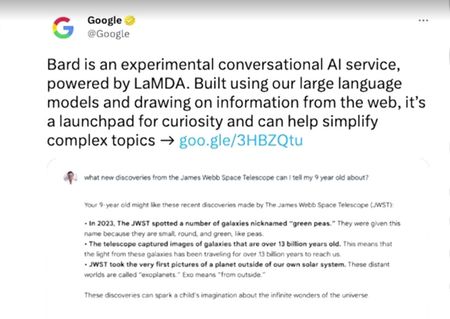
Alphabet posted a short GIF video of Bard in action via Twitter, promising it would help simplify complex topics, but it instead delivered an inaccurate answer.

In the advertisement, Bard is given the prompt: “What new discoveries from the James Webb Space Telescope (JWST) can I tell my 9-year old about?” Bard responds with a number of answers, including one suggesting the JWST was used to take the very first pictures of a planet outside the Earth’s solar system, or exoplanets. The first pictures of exoplanets were, however, taken by the European Southern Observatory’s Very Large Telescope (VLT) in 2004, as confirmed by NASA.

“This highlights the importance of a rigorous testing process, something that we’re kicking off this week with our Trusted Tester program,” a Google spokesperson said. “We’ll combine external feedback with our own internal testing to make sure Bard’s responses meet a high bar for quality, safety and groundedness in real-world information.”

FORMIDABLE COMPETITOR

Alphabet is coming off a disappointing fourth quarter as advertisers cut spending.

The search and advertising giant is moving quickly to keep pace with OpenAI and rivals, reportedly bringing in founders Sergey Brin and Larry Page to accelerate its efforts.

“People are starting to question is Microsoft going to be a formidable competitor now against Google’s really bread-and-butter business,” said King Lip, chief strategist at Baker Avenue Wealth Management, which owns Alphabet and Microsoft shares.

Lip cautioned, though, that concerns about Alphabet may be overblown, saying: “I think still Bing is a far, far cry away from Google’s search capabilities.”

The new ChatGPT software has injected excitement into technology firms after tens of thousands of job cuts in recent weeks and executive pledges to pare back on so-called moonshot projects. AI has become a fixation for tech executives who have mentioned it as much as six times more often on recent earnings calls than in prior quarters, Reuters found.

The appeal of AI-driven search is that it could spit out results in plain language, rather than in a list of links, which could make browsing faster and more efficient. It remains unclear what impact that might have on targeted advertising, the backbone of search engines like Google.

Chatbot AI systems also carry risks for corporations because of inherent biases in their algorithms that can skew results, sexualize images or even plagiarize, as consumers testing the service have discovered. Microsoft, for instance, released a chatbot on Twitter in 2016 that quickly began generating racist content before being shut down. And an AI used by news site CNET was found to produce factually incorrect or plagiarized stories.

At the time of writing, the Bard ad had been viewed on Twitter more than a million times.

(Reporting by Martin Coulter; Additional reporting by Johann Cherian, Eva Mathews, Lewis Krauskopf; Editing by David Gregorio and Christopher Cushing)

tagreuters.com2023binary_LYNXMPEJ1710T-VIEWIMAGE

tagreuters.com2023binary_LYNXMPEJ170VU-VIEWIMAGE

tagreuters.com2023binary_LYNXMPEJ170RM-VIEWIMAGE