Categories
Latest Market News Stock Whispers Technology

Is Now the Time to Invest in Meme Stock ETFs?

The financial markets are witnessing a notable resurgence of meme stocks, highlighted by the return of Keith Gill, famously known as Roaring Kitty, after a hiatus of three years. His reappearance has sparked renewed vigor in stocks like GameStop Corp (GME) and AMC Entertainment Holdings Inc (AMC), both of which experienced noticeable price increases following his social media activity. This phenomenon has caught the eye of investors eager to leverage the growing momentum.

For those inclined to tap into this wave, several ETFs present lucrative opportunities. Among them, the VanEck Social Sentiment ETF (BUZZ) emerges as a top contender. This ETF, with an asset base of $67.2 million, primarily invests in large-cap U.S. stocks that enjoy a positive reputation on social media platforms. Tracking the BUZZ NextGen AI US Sentiment Leaders Index, it includes notable meme stocks like GameStop and AMC. With a relatively modest annual fee of 0.75%, BUZZ offers an avenue for investors to harness the social media-driven enthusiasm surrounding these stocks.

Another intriguing option is the SoFi Social 50 ETF (SFYF), which curates its portfolio from the top 50 U.S. stocks that are predominantly held on the SoFi Invest platform. This ETF provides exposure to sectors that resonate well with retail investors, including consumer cyclicals, technology, and communications, holding assets worth $17.1 million and charging a fee of 0.29% annually. It caters specifically to those interested in the pulse of market trends influenced by retail trading behaviors.

On a different note, the Amplify Transformational Data Sharing ETF (BLOK) focuses on blockchain technology but also dips into the meme stock waters by including key players in digital finance like MicroStrategy Inc (MSTR) and Coinbase Global Inc (COIN). With an asset pool of $702.8 million and an annual fee of 0.76%, BLOK offers a diversified portfolio that not only taps into the meme stock narrative but also mitigates risk through its broader technological and financial focus.

The reemergence of Roaring Kitty and the ensuing rally in meme stocks underscore a unique investment landscape where social media influence is undeniable. These ETFs present various strategies for engaging with this volatile yet potentially rewarding market. However, the speculative nature of meme stocks necessitates a cautious approach. Prospective investors should undertake comprehensive research and evaluate their risk tolerance to align their investment decisions with their financial objectives and comfort levels.

In conclusion, the renewed interest in meme stocks, spurred by influential social media personalities, presents both opportunities and challenges. By choosing the right ETFs, investors can navigate this dynamic environment, but the importance of informed decision-making and risk assessment cannot be overstressed in such a speculative investment climate.

Categories
Latest Market News Stock Whispers

Is Now the Time to Invest in Block? Insights from Ark Invest’s Portfolio

In September 2020, Ark Invest, led by Cathie Wood, projected that fintech giant Block (NYSE: SQ) would soar to $375 per share by 2025. At the time, this forecast suggested a 150% upside. However, since then, Block’s stock has plummeted by over 50%, bringing the current price down to $62 per share. This means that Ark’s target now indicates a whopping 505% potential upside.

Despite this significant drop, Wood and her team remain optimistic about Block’s future. Today, Block stands as the fourth-largest holding in Ark’s portfolio, representing 5.4% of their invested assets, compared to being the fifth-largest at 5.6% back in September 2020.

Is Block Set for a Turnaround?

Block has structured its business around two main product ecosystems: Square and Cash App. The Square ecosystem includes a range of hardware, software, and banking services designed to support merchants in both physical and digital sales environments. This integrated approach sets Square apart from traditional, fragmented payment processing solutions typically used by small and medium-sized businesses.

Similarly, Cash App provides a comprehensive platform where users can save, spend, borrow, and invest money. This all-encompassing nature simplifies personal finance management, resonating well with consumers. Notably, Cash App ranked as the ninth-most downloaded mobile app in the U.S. last year and the most downloaded financial app.

In its first-quarter financial results, Block exceeded expectations on both revenue and earnings. Total gross profit rose by 22% to $2 billion, driven by a 25% increase in Cash App and a 19% increase in Square. Non-GAAP net income skyrocketed by 98%, reaching $0.85 per diluted share.

Square Ecosystem Performance

Square has made strides in monetizing larger and international sellers. Mid-market sellers—merchants with an annualized gross payment volume (GPV) of at least $500,000—represented 39% of Square’s GPV in the first quarter, up from 38% the previous year. International sellers contributed 13% of Square’s gross profit, up from 11% last year.

However, total Square GPV grew by only 9% in the first quarter, a notable slowdown from 17% growth the previous year. This sluggish GPV growth led to a modest 9% increase in transaction revenue. Nonetheless, this was balanced by a 29% rise in subscription and services revenue, bolstered by products like Square Loans and Square Debit Card.

Cash App Ecosystem Performance

Cash App continues to attract and engage more users. The number of monthly transacting users grew by 6% to 57 million in the first quarter, with average inflows per user increasing by 11% to $1,255—a sequential acceleration from 8% growth in the fourth quarter. This is encouraging as Block focuses on boosting paycheck deposit adoption and inflows per active user to establish Cash App as a primary banking platform.

Moreover, the number of Cash App Card users increased by 20% to 24 million, while buy now pay later (BNPL) volume surged by 25% compared to the previous year. Cash App Pay volume also jumped by 40% compared to the prior quarter, indicating deeper engagement across its suite of financial services.

Reconciling Ark’s Ambitious Valuation with Reality

In 2020, Ark Invest’s prediction of $375 per share by 2025 hinged on trailing-12-month (TTM) gross profit growing at 53% annually to hit $15.7 billion by the fourth quarter of 2025. However, TTM gross profit has only grown at 40% annually, reaching $7.9 billion through the first quarter of 2024. To meet Ark’s target, Block would need to double its TTM gross profit in the next seven quarters, necessitating a substantial acceleration.

Additionally, Ark’s target implies a market capitalization of $182 billion, translating to a valuation of 11.6 times gross profit. Currently, investors are valuing Block at just 4.9 times gross profit, far below Ark’s expectation.

Potential for a Market-Beating Turnaround

Block’s stock, trading at $150 per share when Ark released its model, has since fallen by 57%, while the S&P 500 (SNPINDEX: ^GSPC) has climbed by 64%. Despite this, Block could still be a comeback story. The company has tapped less than 5% of its $205 billion addressable market in gross profit. Wall Street anticipates Block’s earnings per share will grow at 41% annually over the next three to five years. This growth prospect makes the current valuation of 78.7 times earnings appear reasonable.

Moreover, Block’s price-to-gross-profit multiple of 4.9 is a significant discount compared to its three-year average of 11.6. From this vantage point, Block has the potential to outperform the market in the coming years.

Key Takeaways

  • Ark Invest remains optimistic about Block despite a significant drop in share price.
  • Block’s integrated ecosystems, Square and Cash App, are showing signs of deeper user engagement and growth.
  • Ark’s initial valuation model may have been overly ambitious, but Block still has potential for substantial upside.
  • Wall Street’s growth expectations and current valuation suggest Block could be a market-beating investment.

Conclusion

While Ark’s initial forecast for Block may have been overly optimistic, the fintech company still presents a compelling growth story. With a solid position in Ark’s portfolio and significant growth potential, Block could indeed turn around and reward investors in the years ahead.

Categories
Latest Market News Stock Whispers

REIT Insiders Invest Heavily Amid Sector Downturn

As the broader markets have been riding a wave of optimism, the real estate sector, particularly Real Estate Investment Trusts (REITs), has not shared in the recent euphoria. While the S&P 500 index has soared by an impressive 41%, the Vanguard Real Estate exchange-traded fund (ETF), representing a broad spectrum of real estate investments, has only managed a modest 2% gain from the start of the year.

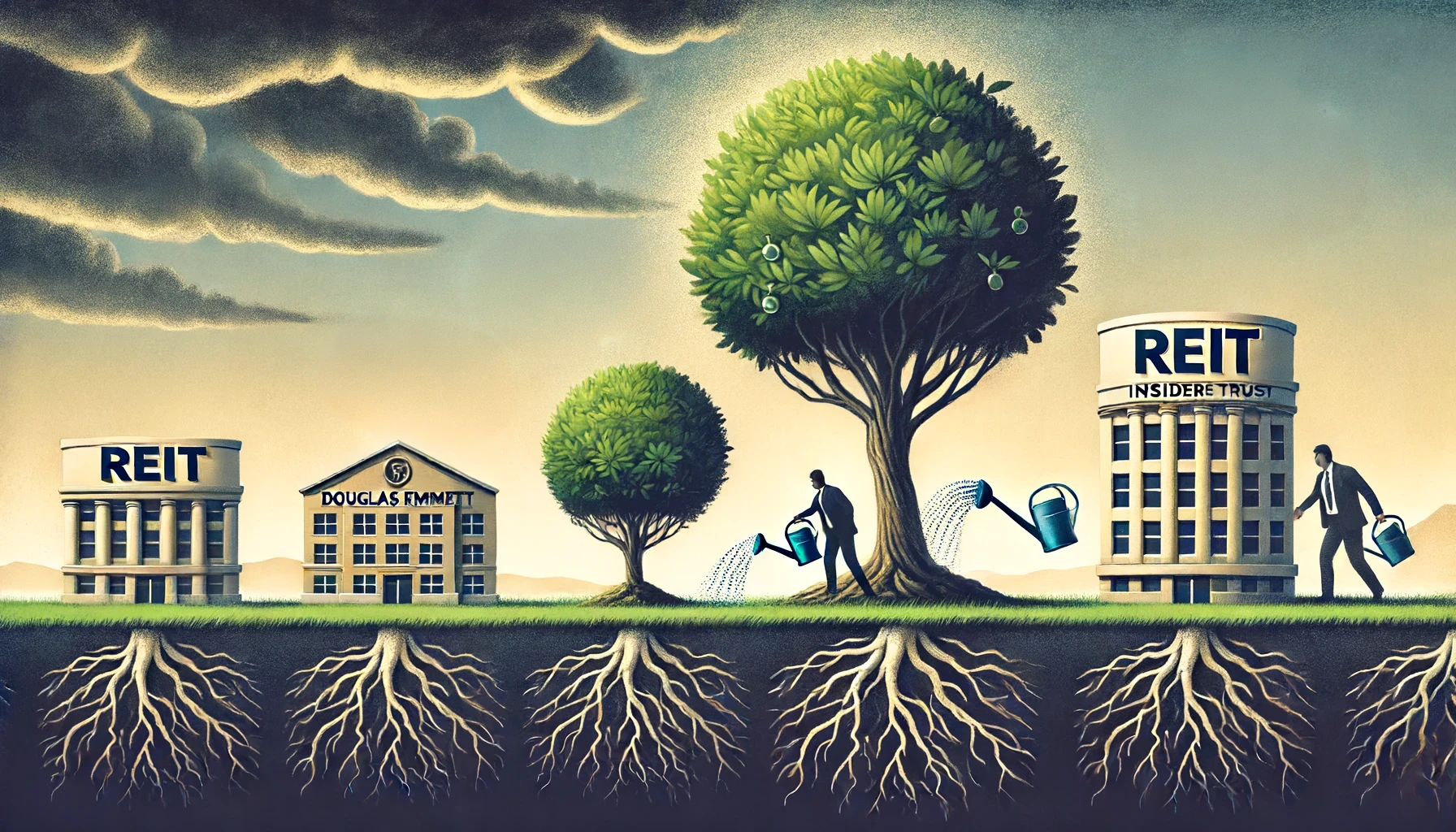
This sector’s struggle is rooted in several challenges, notably the adverse effects of high interest rates and a weak demand for office space. These conditions have pressed property values downwards, overshadowing the sector with gloomy projections. Despite this, insiders at three noteworthy REITs—National Storage Affiliates Trust, Douglas Emmett, and AFC Gamma—have significantly increased their stakes, signaling a strong belief in the resilience and future recovery of their companies.

National Storage Affiliates Trust, specializing in self-storage properties, saw its trustee Chad Meisinger acquire 18,405 shares for $694,600, using funds from a self-directed retirement account. This purchase follows a pivotal internalization announcement by the company, which is expected to significantly boost earnings over time. Despite the stock’s slight 1.5% dip this year, Meisinger’s actions reflect confidence in a recovery and an enduring positive outlook for the sector.

Similarly, in the office and multifamily property sector, Douglas Emmett’s director William E. Simon Jr. expanded his holdings by purchasing 45,000 shares for $591,800. His decision came despite the company’s shares losing 8.3% of their value year to date, suggesting a tactical move to capitalize on lower prices.

On the brighter side, AFC Gamma, which caters to the legalized cannabis industry, has seen its shares appreciate by 3.1% this year. Leonard M. Tannenbaum, the founder and executive chairman, invested $1.1 million in the company’s shares. His investments were distributed across both a foundation and his personal account, reinforcing his bullish stance on the company’s prospects, especially ahead of its planned spinoff of Sunrise Realty Trust.

This wave of insider buying in the REIT sector underscores a noteworthy trend: despite the external economic pressures and the sector’s underperformance relative to the broader market, company leaders are demonstrating their faith in the inherent value and future potential of their properties. This strategic positioning by insiders could suggest an anticipatory move, betting on a sector rebound as conditions stabilize or even improve.

In conclusion, while the real estate investment landscape remains peppered with challenges, the robust insider buying activities at these REITs offer a beacon of optimism. For investors, this could represent a unique opportunity to align with those who are not just navigating the storm but are actively preparing for clearer skies ahead. Such insider confidence might be an early signal of a turning tide in the beleaguered real estate sector, meriting closer attention from those looking for potential opportunities in undervalued areas of the market.

Categories
Stock Whispers US

What Makes Buffett’s Top Dividend Stocks a Safe Bet?

Warren Buffett, known as the “Oracle of Omaha,” has maintained a legendary status in the investing world for decades. His annual Berkshire Hathaway shareholders meeting attracts thousands of devoted investors, a testament to his unparalleled reputation and successful track record over the past fifty years.

Buffett’s enduring investment philosophy of buying high-quality companies with globally recognized products and services that pay dividends has withstood the test of time. As the stock market appears significantly overbought and vulnerable to a steep correction, we examined Berkshire Hathaway’s portfolio for companies well-positioned to endure a potential 20% or greater market decline. Here are five top Berkshire holdings that are rated Buy by leading Wall Street firms and offer substantial, reliable dividends.

Why Warren Buffett Stocks?

Our extensive experience of over 15 years in covering Warren Buffett and Berkshire Hathaway at 24/7 Wall St. involves continuous monitoring of their portfolio to identify stocks suited for the current investment climate. Following a significant market surge over the past 18 months, safer investment options are now more attractive.

Bank of America (NYSE: BAC)

Bank of America is a prominent multinational investment bank and financial services company. The firm recently posted strong first-quarter results and offers a robust 2.48% dividend yield. Bank of America’s extensive operations include:

  • Banking and financial services for individual consumers, small and mid-market businesses, institutional investors, corporations, and governments in the U.S. and internationally.
  • Operating 5,100 banking centers, 16,300 ATMs, call centers, and online and mobile banking platforms.

Bank of America’s expansion into new U.S. markets and its global scale ideally position it for accelerated loan growth over the next two years. Unlike smaller competitors, its scale allows for substantial investment increases without significantly impacting returns, thereby driving further market share gains.

Buffett’s Berkshire Hathaway holds 1,032,852,006 shares of Bank of America, comprising 13% of the float and 9.5% of Berkshire’s portfolio.

Chevron (NYSE: CVX)

Chevron is a multinational energy corporation focused on oil and gas. As a safer investment in the energy sector, Chevron offers a generous 4.07% dividend yield. The company operates through two segments:

  • Upstream: Engages in the exploration, development, production, and transportation of crude oil and natural gas. It also handles liquefied natural gas (LNG) processing and transportation.
  • Downstream: Involves refining crude oil, marketing petroleum products and lubricants, manufacturing renewable fuels, and producing commodity petrochemicals and fuel additives.

Chevron’s recent agreement to acquire Hess Corp. for $53 billion underscores its strategic expansion. Under the terms, Hess shareholders will receive 1.025 Chevron shares per Hess share, valuing the transaction’s total enterprise value at $60 billion, including debt.

Berkshire Hathaway owns 122,980,207 shares of Chevron, representing 6.7% of Chevron’s outstanding stock and 5.2% of Berkshire’s portfolio. This holding generates $776,734,888 annually in dividend income.

Coca-Cola (NYSE: KO)

Coca-Cola remains a cornerstone of Buffett’s portfolio, with 400 million shares, amounting to 9.3% of the float and 6.6% of the portfolio. As the world’s largest beverage company, Coca-Cola offers over 500 brands, including:

  • Diet Coke
  • Fanta
  • Sprite
  • Coca-Cola Zero
  • Vitaminwater
  • Powerade
  • Minute Maid
  • Simply

Coca-Cola’s extensive distribution network allows consumers in more than 200 countries to enjoy its products, totaling over 1.9 billion servings daily. Additionally, Coca-Cola owns nearly 20% of Monster Beverage Corp., which continues to deliver impressive results. Investors benefit from a reliable 3.06% dividend yield.

Kraft Heinz (NYSE: KHC)

Kraft Heinz, formed by the merger of H.J. Heinz Company and Kraft Foods Group, is a leading global food company. Berkshire Hathaway’s stake includes 325,634,818 shares, which is 3% of the portfolio and 26.8% of the float. Kraft Heinz generates approximately $25 billion in annual revenues from well-known brands like Kraft, Heinz, Oscar Mayer, and Maxwell House.

As North America’s third-largest food and beverage manufacturer, Kraft Heinz derives 76% of its revenues domestically and 24% internationally. Its extensive brand portfolio includes ABC, Capri Sun, Classico, Jell-O, Kool-Aid, Lunchables, Ore-Ida, Oscar Mayer, Philadelphia, Planters, Plasmon, Quero, Weight Watchers, Smart Ones, and Velveeta. The company offers a substantial 4.47% dividend yield.

Kroger (NYSE: KR)

Kroger is a major American retail company operating supermarkets and multi-department stores across the U.S. Known for its stability, Kroger offers a 2.03% dividend yield. The company operates various store formats, including:

  • Combination food and drug stores with natural and organic food sections, pharmacies, and general merchandise.
  • Multi-department stores offering apparel, home goods, outdoor living products, electronics, and toys.
  • Marketplace stores with full-service grocery, pharmacy, health and beauty care, and general merchandise.
  • Price impact warehouse stores providing grocery, health and beauty items, meat, dairy, baked goods, and fresh produce.

Kroger’s acquisition of Albertsons Companies Inc. for about $1.9 billion aims to merge two of the nation’s largest grocery chains. However, this merger is subject to antitrust review by the Federal Trade Commission, which could delay or derail the process.

Berkshire Hathaway holds 50 million shares of Kroger, representing nearly 7% of the float.

Key Takeaways

  • Diverse Holdings: Buffett’s portfolio spans various sectors, offering stability and growth potential.
  • Strong Dividends: Each of these companies pays substantial dividends, providing consistent income.
  • Strategic Acquisitions: Recent acquisitions by Chevron and Kroger indicate strategic expansion and market consolidation.

Conclusion

Investing in Warren Buffett’s top dividend stocks offers a blend of stability, reliable income, and potential for growth, making them attractive choices amid market uncertainty. These companies, backed by Buffett’s confidence, are well-positioned to weather potential market downturns, ensuring long-term value for investors.


Categories
Stock Whispers

Not Just AI: A Deeper Look at Stocks Shattering Expectations

The artificial intelligence (AI) boom has undeniably propelled Super Micro Computer (Nasdaq: SMCI) into the spotlight. Once a quiet player in the technology realm, its data center servers are now in high demand, catapulting the company onto the Forbes 500 list and driving its market cap to $49.6 billion. With revenue projected to reach $15 billion in fiscal 2024, and a recent addition to the S&P 500 index, Super Micro’s recent success is undeniable. Its strong ties with chipmakers Nvidia and AMD further suggest a bright future.

However, a closer examination of the market reveals a trio of stocks that have outpaced even Super Micro’s meteoric rise in the past year. These companies—Root (Nasdaq: ROOT), Carvana (NYSE: CVNA), and Soleno Therapeutics (Nasdaq: SLNO)—have achieved triple-digit share gains, demonstrating that lucrative opportunities exist beyond the AI frenzy.

Root’s Rapid Ascent

Root (Nasdaq: ROOT) stands out as a prime example of innovation in the auto insurtech sector. Its shares have skyrocketed 975% over the last 12 months, easily outperforming even the AI juggernaut Super Micro Computer. By leveraging mobile technology and data science, Root has streamlined car insurance, offering better rates to safe drivers.

This $733.5 million company is anything but a traditional insurance player. In the first quarter, Root reported a staggering 264% year-over-year increase in revenue, reaching nearly $255 million. This period also marked a shift to profitability, with positive operating income of $5 million.

Industry analysts predict Root’s revenue will grow by 25% annually over the next three years, far exceeding the industry average of 5.9%. While still in its early stages, Root’s ambitious goal of revolutionizing the insurance industry through technology has captured Wall Street’s attention. The average price target of almost $78 per share suggests a potential upside of over 50%.

Carvana’s Resurgence

Carvana (NYSE: CVNA), the online platform for buying and selling used cars, gained widespread recognition during the pandemic-induced supply chain disruptions. After a brief downturn, the company has roared back to life, rewarding investors with a nearly 600% gain over the past year.

While Carvana faced challenges in the wake of the pandemic, the company’s management seems to have successfully steered it back on course. The e-commerce auto platform has been proactively managing its debt, making cash payments on senior secured notes and repurchasing some of it. Positive attention from meme-stock investors may have also contributed to improving the brand’s perception.

Carvana recently reported a record-breaking first quarter, with total revenue growing 17% year-over-year to over $3 billion, driven by the sale of nearly 92,000 retail units. The company also achieved record net income of $49 million, a net income margin of 1.6%, and an adjusted EBITDA margin of 7.7%, surpassing the industry average among listed auto retailers. As long as the auto sales environment remains steady, Carvana is poised to meet its full-year outlook.

Wall Street analysts are optimistic, with Evercore ISI adding the stock to its tactical outperform list.

Soleno Therapeutics Takes Flight

Soleno Therapeutics, a clinical-stage biopharmaceutical company, has seen its shares soar 647% over the past 12 months. The company’s impending inclusion in the Russell 3000 Index will expose it to a broader range of institutional investors seeking diversified holdings in the U.S. market.

With a market cap of $1.6 billion, Soleno Therapeutics is dedicated to treating rare diseases and boasts a robust pipeline of innovative drugs in various stages of development. Last month, the U.S. FDA granted one of its drugs, diazoxide choline therapy for Prader-Willi syndrome patients suffering from extreme hunger, Breakthrough Therapy Designation.

Wall Street analysts are largely bullish on Soleno Therapeutics, with four “buy” ratings and no “sells.” The average price target of $70 per share indicates an anticipated upside of approximately 60%. These examples illustrate that investors can find exceptional returns outside the AI sphere.