Categories
Pharma Stocks

Novo Nordisk finds compounded Wegovy up to 33% impure, sues Florida pharmacies

By Patrick Wingrove

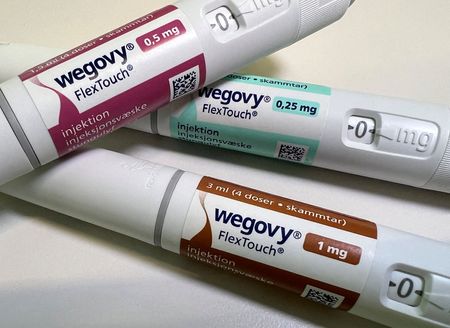
(Reuters) -Novo Nordisk said on Thursday it sued one compounding pharmacy and refiled a lawsuit against another after finding their products claiming to contain the active ingredient for its in-demand weight-loss drug Wegovy were impure, some by as much as 33%.

The Danish drugmaker said it found impurities in all the drugs tested from Wells Pharmacy and Brooksville Pharmaceuticals, both based in Florida. Novo first sued Brooksville in July, and discovered a substance called BPC-157 in samples from Wells.

Both cases were filed in Florida on Wednesday.

Brooksville managing partner Terry Myers said in an email the company disputes the new allegations and plans to file another motion to dismiss. Wells did not respond to a request for comment by email on Thursday.

The U.S. Food and Drug Administration banned BPC-157 from use in compounded drugs in September, saying it did not have enough data to know whether it was harmful to humans, but that it could cause dangerous immune system reactions.

Novo said the compounded versions of Wegovy tested from Brooksville were also less potent than advertised, with one sample shown to be at least 19% weaker than indicated.

“Compounded products do not have the same safety, quality and effectiveness assurances as FDA-approved drugs, and adulterated and misbranded injectable compounded drugs may expose patients to significant health risks,” Jason Brett, a Novo Nordisk executive, said in a statement.

Novo said the lawsuits aim to stop the two pharmacies from selling products claiming to contain semaglutide – the main ingredient in Wegovy and Ozempic – and prevent Wells Pharmacy from claiming its products are FDA approved or that BPC-157 has health benefits without making customers aware of its safety risks.

Brooksville’s Myers said the company buys its bulk ingredients, including semaglutide, from FDA-registered facilities.

It has tested its formulation with a third-party lab and found it remains potent for 180 days when stored in a refrigerator, 90 days when stored at room temperature and 45 days when stored at 40 degrees Celsius.

Novo has already filed 12 lawsuits against medical spas, weight-loss clinics and compounding pharmacies offering products that claim to contain semaglutide.

The company said it had obtained temporary orders against six of those to stop them claiming their products are authentic, FDA approved or associated with Novo Nordisk.

Novo’s biggest rival in the obesity drug market, Eli Lilly, has also sued several medical spas, weight-loss clinics and compounding pharmacies this year to stop them from selling products purporting to contain tirzepatide, the active ingredient in its diabetes drug Mounjaro and recently-approved weight loss medicine Zepbound.

The case against Wells was filed in the U.S. District Court, Middle District of Florida, Ocala division and the suit against Brooksville in U.S. District Court, Middle District of Florida, Tampa division.

(Reporting by Patrick Wingrove; Additional reporting by Josephine Mason;Editing by Bill Berkrot, Jane Merriman and Susan Fenton)

tagreuters.com2023binary_LYNXMPEJAT0EY-VIEWIMAGE

tagreuters.com2023binary_LYNXMPEJAT0EZ-VIEWIMAGE

Categories
Technology

Starting at $60,990, Tesla’s Cybertruck is priced 50% higher than initial estimate

By Akash Sriram, Hyunjoo Jin and Abhirup Roy

(Reuters) -Tesla’s long-delayed Cybertruck will be priced starting at $60,990, over 50% more than what CEO Elon Musk had touted in 2019 and a cost analysts have said will draw select, affluent buyers.

The truck, made of shiny stainless steel and shaped into flat planes, is partly inspired by a car-turned-submarine in the 1977 James Bond movie “The Spy Who Loved Me,” Musk has said.

Its new body material and unconventional, futuristic styling has added complexity and costs to production, and threatens to alienate traditional pickup truck buyers who focus on utility, experts say.

But Musk, who has priced the vehicle’s three variants between $60,990 and $99,990, said on Thursday the Cybertruck has “more utility than a truck” and is “faster than a sports car.”

He drove a Cybertruck onto a stage to cheers from the crowd and later handed over vehicles to about a dozen customers at an event in Austin, Texas.

“Finally, the future will look like the future,” he said about the truck’s design, showing a video of the Cybertruck towing a Porsche 911 and beating another gasoline-powered 911 in a short race.

Tesla shares fell 2% in extended trading after closing off 1.6% at $240.08.

Musk did not announce the vehicle’s prices at the event, but Tesla’s website listed the prices. Its highest performance variant, the ‘Cyberbeast’ will be available next year, as will the all-wheel drive trim that starts at an estimated $80,000.

The cheapest rear-wheel drive version with an estimated starting price of about $61,000 will be available in 2025.

“This is going to appeal to … definitely a wealthier clientele that can afford the price point and they want something that is unique and quirky,” said Jessica Caldwell, head of insights at auto research firm Edmunds.

“That just isn’t a large segment of the population that can afford that especially where interest rates are.”

After Musk estimated in 2019 that the Cybertruck would sell for $40,000, the vehicle drew more than a million reservation holders who put down $100 deposits. He had not offered an updated price before Monday, despite rising raw material costs for EVs.

New deposits are $250, Musk said on Thursday.

The price is not a surprise to many, said Paul Waatti, an analyst at consultancy AutoPacific. Waatti told Reuters before the event that the Cybertruck would do well with a smaller audience.

GRANDSTANDING SHOWPIECE

Cybertruck, two years behind schedule, enters a hot pickup truck market to compete with the likes of Ford’s F150 Lightning, Rivian Automotive’s R1T and General Motors’ Hummer EV.

Rivian’s R1T has a starting price of $73,000, while the F-150 Lightning starts at about $50,000. The larger and more powerful Hummer EV pickup costs more than $96,000.

The Cybertruck, Tesla’s first new model in nearly four years, is critical to its reputation as a maker of innovative vehicles. At a time when the company is battling softening electric vehicle (EV) demand and rising competition, Cybertruck is also key for generating sales, though not to the extent of the company’s high-volume Models 3 and Y.

Musk tempered investor expectations about the product last month citing problems in ramping production and warning that it would take a year to 18 months to make it a significant cash flow contributor.

Ahead of the launch, Musk captured media attention on a different subject, giving a profanity-laced interview to the New York Times on Wednesday. He cursed advertisers who left his social media platform X, formerly known as Twitter, because of antisemitic comments.

On Thursday, he said about the truck: “It’s basically an incredibly useful truck. It’s not just some grandstanding showpiece like me.”

UNIMPRESSIVE RANGE

The Cybertruck’s longest-range version can drive an estimated 340 miles (547 km), and comes with a “range extender” or extra battery pack that extends its range to 470 miles.

In 2019, Musk had said the truck would be able to travel 500 miles or more on a single charge.

“As a truck, the Ford and Chevy are more useful and certainly easier to see out of,” said Sam Abuelsamid, principal research analyst at Guidehouse Insights.

“Given that Teslas almost always fall short of (range) estimates in real world driving by anywhere from 10%-20%, I wouldn’t expect the longest range version of the Cybertruck to achieve more than 300 miles on the road,” he said, noting that the Chevrolet Silverado EV is capable of exceeding its 450-mile rated range.

Musk has said Tesla was likely to reach a production rate of roughly 250,000 Cybertrucks a year in 2025. He did not update that on Thursday.

During its 2019 reveal, Tesla’s chief designer Franz von Holzhausen took a metal ball to demonstrate the truck’s unbreakable “armor glass” window, only to shatter it.

Holzhausen on Thursday lobbed a baseball at the Cybertruck window that bounced off.

(Reporting by Akash Sriram in Bengaluru, and Hyunjoo Jin and Abhirup Roy in San Francisco; Writing by Sayantani Ghosh; Editing by Bill Berkrot, Peter Henderson and Deepa Babington)

tagreuters.com2023binary_LYNXMPEJAT0E6-VIEWIMAGE

tagreuters.com2023binary_LYNXMPEJAT0EK-VIEWIMAGE

tagreuters.com2023binary_LYNXMPEJAT0EL-VIEWIMAGE

Categories
Resource Stocks

Panama president directs First Quantum to shut copper mine after court ruling

By Elida Moreno and Valentine Hilaire

PANAMA CITY (Reuters) – Panama’s president said on Tuesday that Canadian miner First Quantum’s lucrative copper mine Cobre Panama would be shut down, hours after the country’s Supreme Court declared its contract unconstitutional.

President Laurentino Cortizo said in a televised address on Tuesday evening that “the orderly and safe closure of the mine” would begin as soon as the Supreme Court’s ruling was formerly published in the official gazette.

Cobre Panama has sparked public anger in the country that has spilled into street protests. The protests began as small, environmental ones against the mine but have morphed into broader demonstrations against the government amid charges the contract was too generous.

First Quantum said on Tuesday it had suspended commercial production at the mine and was putting in into care and maintenance.

The ruling puts the company on the long and unpredictable road of international arbitration, although it has suggested it would seek to avoid the process if possible through pre-arbitration talks with the Panamanian government.

The contract in dispute was agreed last month by Panama’s government and provided First Quantum a 20-year mining right with an option to extend for another 20 years, in return for $375 million in annual revenue to Panama.

“We have decided to unanimously declare unconstitutional the entire law 406 of October 20, 2023,” Supreme Court President Maria Eugenia Lopez said on Tuesday.

First Quantum acknowledged the ruling and affirmed its “unwavering commitment to regulatory compliance in all aspects of our operations within the country.”

Protester groups on social media said they would keep demonstrating until the ruling was published in the official gazette.

First Quantum shares closed down 0.8%. The company has lost more than C$10 billion ($7.4 billion) of its market value since the protests started in late October and the mine was later forced to suspend production.

The ruling will also have consequences for the copper market, as Cobre Panama accounts for about 1% of global copper production. Benchmark copper on the London Metal Exchange was up 0.9% at $8,441 a metric ton.

Dwindling copper supply from Panama and Peru could wipe out global surplus in 2024, analysts said.

ELECTION FACTOR

Cobre Panama is an equally significant business for the Central American nation, contributing about 5% of Panama’s GDP. J.P. Morgan warned this month that the odds of Panama losing its investment-grade rating would rise significantly if the contract was revoked.

The fierce opposition toward the deal was becoming a major factor in the country’s May 2024 presidential election, with candidates pushing for more state control of the mine.

The company’s Panama unit in a statement on Tuesday said it would “remain attentive to constructive dialogue” on the mining contract before deciding its course of action.

A spokesperson for Canada’s foreign ministry said it respects the decision of Panama’s Supreme Court of Justice and was closely following the contract negotiations.

Former president, millionaire businessman and leading presidential candidate Ricardo Martinelli last week proposed that Panama renegotiate the contract with the Canadian firm to secure higher royalties and a stake in the project.

But in response to the protests, Panama’s government enacted a bill in November banning all new mining concessions and extensions that legal experts have said would prevent the two parties from negotiating a new deal.

    The country’s top court ruled against First Quantum’s previous contract in 2017. The decision was upheld in 2021, but the current government allowed the miner to keep operating while both parties negotiated a new deal.

For First Quantum, the Panama ruling would be a repeat of its experience in the Democratic Republic Of Congo, where it exited in 2012 after filing an arbitration procedure against the African country for cancelling its mining contract.

First Quantum sold its assets to Eurasian Natural Resources Corporation PLC for $1.25 billion and settled the dispute.

The company has spent about $10 billion in developing the Cobre Panama mine over a decade. The mine produced 112,734 tonnes of copper in the third quarter and accounted for about 46% of its overall third-quarter revenue of $2.02 billion, according to the company.

($1 = 1.3590 Canadian dollars)

(Reporting by Elida Moreno and Valentine Hilaire; Additional reporting by Divya Rajagopal and Natalia Siniawski; Writing by Denny Thomas; Editing by Mark Porter and Rosalba O’Brien)

tagreuters.com2023binary_LYNXMPEJAR0KE-VIEWIMAGE

Categories
Energy

Biden’s clean energy agenda faces mounting headwinds

(This Nov. 24 story has been officially corrected to fix tracking firm LevelTen’s data to show that solar contract prices reached their highest level this decade, not ever, in paragraph 14)

By Nichola Groom and Jarrett Renshaw

(Reuters) – Canceled offshore wind projects, imperiled solar factories, fading demand for electric vehicles.

A year after passage of the largest climate change legislation in U.S. history, meant to touch off a boom in American clean energy development, economic realities are fraying President Joe Biden’s agenda.

Soaring financing and materials costs, unreliable supply chains, delayed rulemaking in Washington and sluggish permitting have wrought havoc ranging from offshore wind developer Orsted’s project cancellations in the U.S. Northeast, to Tesla, Ford and GM’s scaled back EV manufacturing plans.

The darkening outlook for clean energy industries is tough news for Biden, whose pledge to deliver a net-zero economy by 2050 faces headwinds that the landmark Inflation Reduction Act’s billions in tax credits alone can’t resolve.

After walking into last year’s United Nations climate summit in Egypt touting the IRA as evidence of unprecedented progress in the fight against climate change, Biden is expected to skip this year’s event in Dubai amid dire warnings that the world is moving too slowly to avert the worst of global warming.

Clean energy experts interviewed by Reuters say the mounting setbacks will make the United States’ ambitious targets to decarbonize by mid-century even harder to reach.

“While we see healthy numbers being deployed each and every quarter and we’re continuing to be on a growth path, it’s certainly not at the level that is required to hit some of those targets,” said John Hensley, vice president for the clean energy trade group American Clean Power Association (ACP).

The dynamics of soaring costs and broken supply chains are also slamming projects in other regions. No major nation is on track to meet the emissions reduction goals outlined in the United Nations’ Paris accord, which aims to limit global warming to 1.5 degrees Celsius, according to Wood Mackenzie.

A White House official said that while there have been macroeconomic setbacks and bottlenecks at the local level to renewable energy deployment, there are plenty of examples of progress, including an expanding EV market and Dominion Energy Inc making headway on the nation’s largest offshore wind farm off the coast of Virginia.

“In the face of headwinds that are macro in nature, headwinds that affect decision making across the economy, this has been a resilient trajectory,” White House National Climate Advisor Ali Zaidi said in an interview. He said the United States will achieve it’s climate goals.

TEN MILLION HOMES

More than 56 gigawatts of clean power projects, enough to power nearly 10 million homes, have been delayed since late 2021, according to an ACP analysis. Solar energy facilities account for two thirds of those delays due in part to U.S. import restrictions. Washington has been trying to combat the use of forced labor and tariff-dodging in a panel supply chain that is dominated by Chinese goods.

Issues like permitting gridlock, local fights over where to site solar and wind projects and a grid connection process that can take an average of five years are also routinely cited by developers as among the industry’s biggest challenges.

“In a number of areas investment has increased,” Prakash Sharma, vice president of scenarios and technologies at Wood Mackenzie said in an interview. “But then when it comes to some of those permitting and approvals that are required to push projects forward, or infrastructure development, that’s an issue which IRA cannot solve.”

Tight supplies and strong demand for renewables from utilities and corporations have also driven up contract prices, which could mean higher costs for consumers. Solar contract prices rose 4% to hit $50/MWh for the first time this decade in the third quarter, according to tracking firm LevelTen.

Vic Abate, Chief Executive of GE Vernova’s wind business, said progress is happening more slowly than some had anticipated, but was not fundamentally off course.

“I’m not betting against the IRA,” he said in an interview. “This is more of a question of when. If last year people were thinking ’23 to ’24, it’s probably more ’24 to ’25.”

The IRA aims to shore up the U.S. clean energy supply chain by incentivizing domestic production of equipment like solar panels and wind turbines, but recently manufacturers have warned that a wave of new Asian capacity is threatening the viability of dozens of planned American factories.

Turmoil in the nascent U.S. offshore wind industry, meanwhile, is perhaps the most high profile setback. Developers like Orsted, BP and Equinor have sought to renegotiate or cancel contracts due to soaring costs, and have taken multi-billion dollar writedowns on projects. Players also largely failed to show up for a federal sale of wind leases in the Gulf of Mexico in August. The Biden administration’s target of deploying 30 gigawatts of offshore wind by 2030 is now widely regarded as unattainable.

Meanwhile, some corporations are delaying investment decisions while awaiting the Treasury Department to craft rules on how the IRA’s tax credits can be used.

Robert Walther, director of federal affairs at ethanol maker POET, for example, says his company is waiting on the design of tax credits for sustainable aviation fuel under the IRA, to see whether the corn-based fuel can qualify as a feedstock.

“We’re not pulling the trigger on anything until we know what the value of these tax credits are,” Walther said.

Still, the U.S. can be proud of how it is tackling climate change, particularly when compared with the Trump administration’s relatively recent efforts to roll back policies that protect the climate, according to Dan Reicher, a scholar at Stanford University.

“These are the normal ups and downs of clean energy development and deployment,” Reicher said.

“I think we can go to COP with our chin held high that we’re making some real progress.”

(Reporting by Nichola Groom; Editing by Richard Valdmanis and Alistair Bell)

tagreuters.com2023binary_LYNXMPEJAN0CP-VIEWIMAGE

tagreuters.com2023binary_LYNXMPEJAN0CQ-VIEWIMAGE

Categories
Technology

Volkswagen to reduce headcount at ‘no longer competitive’ VW brand

BERLIN (Reuters) -Volkswagen’s 10 billion euro ($10.9 billion) savings programme will include staff reductions, managers told staff on Monday as brand chief Thomas Schaefer warned that high costs and low productivity were making its cars uncompetitive.

The German carmaker is in the midst of negotiations with its works council over a cost-cutting scheme at its VW brand, the first step in a group-wide drive to boost efficiency in the transition to electric cars.

“With many of our pre-existing structures, processes and high costs, we are no longer competitive as the Volkswagen brand,” Schaefer told a staff meeting at the carmaker’s headquarters in Wolfsburg, according to a post on the company’s intranet site and seen by Reuters.

The company had previously said it planned to take advantage of the “demographic curve” to reduce its workforce, having pledged that it would not carry out dismissals until 2029.

In Monday’s meeting, human resources board member Gunnar Kilian said this would be achieved through agreements on partial or early retirement.

However, the bulk of the 10 billion euro savings goal would be achieved through measures other than personnel reduction, Kilian added, with the full details to be defined by the end of the year.

“We need to finally be brave and honest enough to throw things overboard that are being duplicated within the company or are simply ballast we don’t need for good results,” Kilian said.

($1 = 0.9168 euros)

(Reporting by Victoria WalderseeWriting by Matthias WilliamsEditing by Miranda Murray and David Goodman)

tagreuters.com2023binary_LYNXMPEJAQ0C9-VIEWIMAGE

Categories
Technology

Judge finds evidence that Tesla, Musk knew about Autopilot defect

By Hyunjoo Jin and Dan Levine

(Reuters) -A Florida judge found “reasonable evidence” that Tesla Chief Executive Elon Musk and other managers knew the automaker’s vehicles had a defective Autopilot system but still allowed the cars to be driven unsafely, according to a ruling.

Judge Reid Scott, in the Circuit Court for Palm Beach County, ruled last week that the plaintiff in a lawsuit over a fatal crash could proceed to trial and bring punitive damages claims against Tesla for intentional misconduct and gross negligence. The order has not been previously reported.

The ruling is a setback for Tesla after the company won two product liability trials in California earlier this year over the Autopilot driver assistant system. A Tesla spokesperson could not immediately be reached for comment on Tuesday.

The Florida lawsuit arose out of a 2019 crash north of Miami in which owner Stephen Banner’s Model 3 drove under the trailer of an 18-wheeler big rig truck that had turned onto the road, shearing off the Tesla’s roof and killing Banner. A trial set for October was delayed, and has not been rescheduled.

Bryant Walker Smith, a University of South Carolina law professor, called the judge’s summary of the evidence significant because it suggests “alarming inconsistencies” between what Tesla knew internally, and what it was saying in its marketing.

“This opinion opens the door for a public trial in which the judge seems inclined to admit a lot of testimony and other evidence that could be pretty awkward for Tesla and its CEO,” Smith said. “And now the result of that trial could be a verdict with punitive damages.”

The Florida judge found evidence that Tesla “engaged in a marketing strategy that painted the products as autonomous” and that Musk’s public statements about the technology “had a significant effect on the belief about the capabilities of the products.”

Scott also found that the plaintiff, Banner’s wife, should be able to argue to jurors that Tesla’s warnings in its manuals and “clickwrap” agreement were inadequate.

The judge said the accident is “eerily similar” to a 2016 fatal crash involving Joshua Brown in which the Autopilot system failed to detect crossing trucks, leading vehicles to go underneath a tractor trailer at high speeds.

“It would be reasonable to conclude that the Defendant Tesla through its CEO and engineers was acutely aware of the problem with the ‘Autopilot’ failing to detect cross traffic,” the judge wrote.

Banner’s attorney, Lake “Trey” Lytal III, said they are “extremely proud of this result based in the evidence of punitive conduct.”

The judge also cited a 2016 video showing a Tesla vehicle driving without human intervention as a way to market Autopilot. The beginning of the video shows a disclaimer which says the person in the driver’s seat is only there for legal reasons. “The car is driving itself,” it said.

That video shows scenarios “not dissimilar” than what Banner encountered, the judge wrote.

“Absent from this video is any indication that the video is aspirational or that this technology doesn’t currently exist in the market,” he wrote.

(Reporting by Dan Levine; Editing by Richard Chang and Stephen Coates)

Categories
Pharma Stocks

Texas AG sues Pfizer over quality-control lapses in kids’ ADHD drug

By Brendan Pierson

(Reuters) -Texas Attorney General Ken Paxton accused Pfizer and its supplier Tris Pharma of providing children’s ADHD medicine that it knew might be ineffective to the state’s Medicaid insurance program for low-income people, in a lawsuit unsealed on Monday.

The lawsuit, filed in Harrison County, Texas District Court, alleges that Pfizer and Tris manipulated quality-control testing for the drug Quillivant XR in order to obtain passing results from tests it was required to perform under federal law between 2012 and 2018. Properly done tests frequently showed that the drug failed to dissolve as it was supposed to, a sign that it would not be released in the body as expected, the lawsuit said.

The lawsuit also alleged that Pfizer, despite knowing of the quality-control issues, persuaded Texas’ Medicaid program to add Quillivant to its list of preferred drugs.

Paxton alleged that many Texas families complained that Quillivant failed to work.

“I am horrified by the dishonesty we uncovered in this investigation,” Paxton, a Republican, said in a statement. The lawsuit accuses the companies of defrauding the state’s Medicaid program, and seeks unspecified money damages from the companies.

Pfizer said in a statement that it had examined the allegations in the complaint on “multiple occasions” and “did not find any impact on the safety of the product.” It said it believed the case had no merit and would move to dismiss it.

A spokesperson for Tris said in an email: “We categorically deny and intend to rigorously defend these allegations in the court of law.”

Tris manufactured Quillivant for Pfizer until 2018, when it acquired the product from Pfizer.

The lawsuit stems from a whistleblower complaint by Tarik Ahmed, who worked as Tris’ head of technology from 2013 to 2017.

Quillivant was developed by Nextwave Pharmaceuticals, a company acquired by Pfizer in 2012.

Like other drugs for attention deficit/hyperactivity disorder, it has been plagued by shortages, and never achieved a large national market share. Tris acquired the product in 2018.

The U.S. Food and Drug Administration in 2017 warned Tris of manufacturing lapses.

In its 2022 annual report, Pfizer said it had received a subpoena from federal prosecutors in the Manhattan-based Southern District of New York related to its relationship with Tris and the production of Quillivant in 2018, but had not heard anything further after responding.

(Reporting by Brendan Pierson in New York, Editing by Alexia Garamfalvi and Matthew Lewis)

tagreuters.com2023binary_LYNXMPEJAK00O-VIEWIMAGE

Categories
Crypto

US SEC sues Kraken crypto exchange over failure to register

By Jonathan Stempel

(Reuters) -Kraken, one of the world’s largest cryptocurrency exchanges, was sued on Monday by the U.S. Securities and Exchange Commission, which accused it of illegally operating as a securities exchange without first registering with the regulator.

The lawsuit in San Francisco federal court is the latest step in SEC Chair Gary Gensler’s push to bring cryptocurrency under his agency’s purview, by contending that digital assets are investment contracts subject to federal securities laws.

Kraken intends to defend itself, saying Congress should decide how to regulate cryptocurrency exchanges and calling the SEC view of digital assets “incorrect as a matter of law, false as a matter of fact, and disastrous as a matter of policy.”

The San Francisco-based exchange also said the lawsuit will not affect its more than 10 million clients.

In June, the SEC filed similar lawsuits against Binance, the world’s largest cryptocurrency exchange, and Coinbase, the largest in the United States. Both are defending against the regulator’s claims.

The SEC said Payward Inc and Payward Ventures Inc, which operate as Kraken, have since 2018 made hundreds of millions of dollars arranging crypto purchases and sales while turning a “blind eye” to securities laws designed to protect investors.

Kraken was also accused of having deficient internal controls and inadequate record keeping, reflected in part in its commingling customer money with its own and paying operating costs directly from customer accounts.

Failing to register has “resulted in a business model rife with conflicts of interest that placed investors’ funds at risk,” SEC enforcement chief Gurbir Grewal said in a statement. “Kraken’s choice of unlawful profits over investor protection is one we see far too often in this space.”

In its statement, Kraken said the SEC complaint conceded that any alleged “commingling” amounted to “no more than Kraken spending fees it has already earned.”

The SEC also accused Binance of commingling customer funds, following a Reuters report describing such conduct. Binance has denied the commingling accusation.

Monday’s lawsuit seeks a civil fine, disgorgement of ill-gotten gains, and a halt to acting as an exchange without registering.

Kraken was founded in 2011. It is backed by investors including Blockchain Capital, Digital Currency Group, Hummingbird Ventures, SkyBridge and Tribe Capital.

The case is SEC v Payward Inc et al, U.S. District Court, Northern District of California, No. 23-06003.

(Reporting by Jonathan Stempel in New York; Additional reporting by Chris Prentice; Editing by David Gregorio, Stephen Coates and Chris Reese)

Categories
Pharma Stocks

Retail investors crowd into Eli Lilly after weight-loss drug approval

By Bhanvi Satija and Amruta Khandekar

(Reuters) – Retail flows into Eli Lilly spiked to a more than two-year high in November, as small investors rushed to buy the stock after the U.S. pharma major received a highly anticipated approval for its weight-loss drug Zepbound. Daily net purchases surged to $14.4 million on Nov. 8, when Zepbound was cleared in the U.S. and the U.K., hitting their highest levels since January 2021, as per data from Vanda Research.

Lilly and Novo Nordisk – seen as leaders in a potential $100 billion obesity treatment market – have helped rekindle retail investor interest in the healthcare sector.

“During the COVID period, retail investors were piling into healthcare because of the vaccines and after that there was a bit of a hangover of purchases. But now with these (weight-loss) drugs, some of it is returning,” said Marco Iachini, senior vice president of research at Vanda Research.

Retail investors are now “catching up” with institutional investors, said Sel Hardy, vice president of equity research at CFRA.

“(Eli Lilly) is almost becoming a household name. A lot of people know about the obesity drug now and the increasing interest and its success,” added Hardy.

Heavyweight investors such as JPMorgan Chase and BlackRock had increased their holdings in the stock in the third quarter.

Lilly’s shares have climbed 61% year-to-date, trading nearly 50 times their 12-month forward earnings, compared with 27.57 times for the U.S. healthcare sector, according to LSEG data.

Net retail purchases of Novo Nordisk shares hit an all-time high in October, according to Vanda data, after its diabetes drug Ozempic showed early success in a trial to treat kidney failure in diabetes patients.

Novo’s American Depository Receipts (ADRs) have risen 47% so far this year.

The surge in interest for the weight-loss drugmakers comes despite a recent decline in overall retail flows to U.S exchanges as the holiday season approaches.

Still, the inflows remain below some of the popular tech stocks like Roblox and AMC, Iachini added.

(Reporting by Bhanvi Satija and Amruta Khandekar in Bengaluru; Editing by Sriraj Kalluvila)

Categories
Resource Stocks

Lithium miner SQM loses $1 billion in market value as lower prices dent profit

By Sarah Morland

(Reuters) -Chile’s SQM, the world’s second-largest lithium producer, saw more than $1 billion wiped from its market value on Thursday as investors reacted to a third quarter profit hammered by sliding prices of the key battery metal.

SQM’s Santiago-listed shares had lost around 8% by early afternoon trading, accounting for some 1 trillion Chilean pesos ($1.13 billion), a day after the company said its net income had more than halved from a year earlier.

In a conference with analysts, executives said they would not slow output, and instead continue producing lithium at maximum capacity and building up warehouse inventories, though sales volumes could be limited in line with market indices.

“The idea is to be prepared when inventories return to the normal level and customer purchases are reactivated,” said SQM’s lithium vice-president Carlos Diaz.

Prices for lithium, an ultralight metal used for electric vehicle (EV) batteries, have dropped more than 60% on fears of softening global demand for EVs. They hit a two-year low this month.

Nevertheless, SQM executives said they expect EV demand to remain resilient in the long-term.

SQM’s senior commercial vice-president for lithium Felipe Smith attributed lower prices to softer EV demand outside China coupled with high component supplies causing excess inventories to accumulate across the whole battery supply chain.

Smith said SQM could contract its sales volumes in line with market indices, adding the firm had also entered into several new long-term index-linked supply deals.

Chile is looking to boost state control over its lithium industry with state miner Codelco leading talks with private miners such as SQM.

The talks cover areas such as how lithium production will be run on the Atacama salt flats, taking into account relations with local communities and environmental sustainability.

“We both agreed that having a sustainable operation in the long-term is the most important target,” SQM Chief Executive Ricardo Ramos said of the talks with Codelco over the Atacama development, adding that he did not expect significant production growth there.

($1 = 882.4700 Chilean pesos)

(Reporting by Sarah Morland; Editing by Valentine Hilaire and Jane Merriman, Kirsten Donovan)