Categories
Energy

Oil prices take a small loss in seesaw session

By Erwin Seba

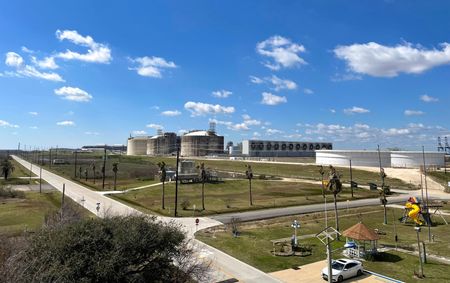
HOUSTON (Reuters) – Brent and U.S. crude futures finished at a small loss following a see-saw session, in which prices fell more than $1 a barrel at one point on Friday, as traders tried to reconcile mixed signals for oil demand in the coming year.

Brent futures settled down 6 cents, or 0.08%, at$76.55 a barrel. U.S. West Texas Intermediate (WTI) crude finished down 15 cents, or 0.21%, at $71.43.

The market tumbled earlier in the session after a New York Federal Reserve Bank manufacturing survey showed a third month of declines in new orders, which could be a sign of weaker demand for oil in the coming year.

“What started the sell off was the sharp drop in the New York manufacturing numbers,” said Phil Flynn, analyst at Price Futures Group.

“This market seems a little more sensitive to every new headline,” Flynn added. “They’re still not sure we’ve found the bottom to this market.”

Traders were also shaken by comments from New York Federal Reserve Bank President John Williams on Friday about hopes for interest rate cuts in the coming year.

“We aren’t really talking about rate cuts right now,” Williams said in an interview with CNBC. When it comes to the question of lowering rates, “I just think it’s just premature to be even thinking about that” at this point, he said.

On Thursday Federal Reserve Chairman Jerome Powell said interest rate hikes intended to curb inflation were likely at an end, but left open the possibility for further increases.

The dollar fell to a four-month low on Thursday after the U.S. central bank after Powell’s comments, seeing signs lower borrowing costs are coming in 2024. The dollar index was broadly steady on Friday.

A weaker dollar makes dollar-denominated oil cheaper for foreign buyers.

World oil consumption will rise by 1.1 million barrels per day (bpd) in 2024, the IEA said in a monthly report.

While that is a 130,000-bpd increase from its previous forecast, the estimate is less than half of the Organization of the Petroleum Exporting Countries’ (OPEC) demand forecast of 2.25 million bpd.

OPEC and its allies led by Russia, in late November agreed on voluntary cuts of about 2.2 million bpd lasting throughout the first quarter.

“The markets in general and oil in particular are trying to sort out what’s going on,” said John Kilduff, partner with Again Capital LLC. “Everyone’s trying to feel their way.”

Money managers cut their net long U.S. crude futures and options positions in the week to December 12, the U.S. Commodity Futures Trading Commission (CFTC) said on Friday.

Another bullish signal for oil markets on Friday was the lower drilling rig count from energy technology firm Baker Hughes. The oil and gas rig count, an early indicator of future output, fell by 3 to 623 in the week to Dec. 15.

Baker Hughes said U.S. oil rigs fell 2 to 501 this week, while gas rigs were unchanged at 119. That brings the rig count down from a post-pandemic high of 784 in December 2022 due to a drop in oil and gas prices.

(Reporting by Erwin Seba; Additional reporting Ahmad Ghaddar and Andrew Hayley; Editing by Susan Fenton, Tomasz Janowski and Diane Craft)

tagreuters.com2023binary_LYNXMPEJBE016-VIEWIMAGE

Categories
Pharma Stocks

Biden administration to impose inflation penalties on dozens of drugs

By Andrea Shalal

BETHESDA, Md. (Reuters) -The Biden administration said on Thursday it had identified 48 drugs in the Medicare program whose prices rose quicker than inflation during the fourth quarter of the year and may require their makers to pay rebates.

President Joe Biden’s signature Inflation Reduction Act (IRA) includes a provision to penalize drugmakers who work with Medicare, a government program for people aged 65 and older or who are disabled.

The 48 drugs it identified fall under Medicare Part B, which covers treatments administered at a health facility.

Medicare recipients could benefit by a reduction in their co-insurance payment for any of the drugs by $1 to $2,786 per average dose, according to a government statement.

The president, in remarks at the National Institutes of Health, said big pharmaceutical companies, in the year before the law was passed, “jacked up” prices nearly four times faster than inflation went up.

“They’re ripping off Medicare. They’re ripping off the American people,” Biden said. “We’re going to save taxpayers money and discourage companies from raising prices in the first place.”

The White House is eager to emphasize the benefits of the IRA in bringing drug prices down ahead of the 2024 election, when Biden, 81, is running for a second term.

In total, prices of 64 drugs increased faster than inflation over the last four quarters, the White House said in a statement.

The IRA aims to save $25 billion annually by 2031 by requiring drugmakers to negotiate the prices of selected expensive drugs with the U.S. Centers for Medicare and Medicaid Service, which oversees Medicare.

The Biden administration last week announced it would create guidelines for when and how it could seize patents for medicines developed with government funding, including considering when their prices are too high.

(Additional reporting by Manas Mishra and Mrinmay Dey in Bengaluru and Jeff Mason in Washington; Editing by Christina Fincher, Arun Koyyur and Aurora Ellis)

tagreuters.com2023binary_LYNXMPEJBD0DV-VIEWIMAGE

Categories
Technology

Tesla recalls nearly all vehicles on US roads over lack of Autopilot safeguards

By David Shepardson

WASHINGTON (Reuters) -Tesla is recalling over 2 million vehicles in the U.S. to install new safeguards in its Autopilot advanced driver-assistance system, after a federal safety regulator cited safety concerns.

The largest-ever Tesla recall appears to cover nearly all vehicles on U.S. roads to better ensure drivers pay attention when using the system. Tesla’s recall filing said that Autopilot’s software system controls “may not be sufficient to prevent driver misuse” and could increase the risk of a crash.

The National Highway Traffic Safety Administration (NHTSA) has spent over two years investigating whether vehicles produced by the electric automaker led by billionaire Elon Musk adequately ensure drivers pay attention.

Acting NHTSA Administrator Ann Carlson praised Tesla for agreeing to the recall. “One of the things we determined is that drivers are not always paying attention when that system is on,” she said at a U.S. House hearing.

Carlson said the agency opened a safety probe in August 2021 when she kept hearing about fatal crashes involving use of Autopilot. “My immediate response was, ‘We have to do something about this,'” she said.

Separately, Transport Canada said Tesla will recall 193,000 vehicles to address the Autopilot issue. It was not immediately clear if China will demand a recall.

Tesla shares were flat Wednesday afternoon.

Tesla’s Autopilot is intended to enable cars to steer, accelerate and brake automatically within their lane, while enhanced Autopilot can assist in changing lanes on highways but does not make vehicles autonomous.

One component of Autopilot is Autosteer, which maintains a set speed or following distance and works to keep a vehicle in its driving lane.

Tesla said it did not agree with NHTSA’s analysis but would deploy an over-the-air software update that will “incorporate additional controls and alerts to those already existing on affected vehicles to further encourage the driver to adhere to their continuous driving responsibility whenever Autosteer is engaged.”

U.S. Senators Ed Markey and Richard Blumenthal said the recall “is critically needed to make Tesla’s cars safer, but it is egregiously overdue… We urge NHTSA to continue its investigations to spur necessary recalls, and Tesla to stop misleading drivers and putting the public in great danger.”

NHTSA said its investigation into Autopilot will remain open as it monitors Tesla’s remedies.

Tesla did not respond to a question on the extent of the recall worldwide or give more precise details of the new safeguards.

‘FORESEEABLE MISUSE’

NHTSA opened its August 2021 probe of Autopilot after identifying more than a dozen crashes in which Tesla vehicles hit stationary emergency vehicles. The probe was upgraded in June 2022.NHTSA said it found Autopilot “can provide inadequate driver engagement and usage controls that can lead to foreseeable misuse.” NHTSA reviewed 956 crashes where Autopilot was initially alleged to have been in use and focused on 322 Autopilot-involved crashes.

Bryant Walker Smith, a University of South Carolina law professor, said the software-only fix will be fairly limited. The recall “really seems to put so much responsibility on human drivers instead of a system that facilitates such misuse.”

Donald Slavik, an attorney representing multiple people suing Tesla alleging Autopilot defects, said some jurisdictions including California could allow plaintiffs to introduce the NHTSA recall into evidence, as well as other post-accident fixes made by Tesla. At the same time, plaintiffs still must prove the defect involved in the recall caused their particular accident.

“This is one step … but it’s not a determination in any case,” Slavik said.

Separately, since 2016, NHTSA has opened more than three dozen Tesla special crash investigations in cases where driver systems such as Autopilot were suspected of being used, with 23 crash deaths reported to date.

NHTSA said there may be increased crash risks when Autopilot is engaged but drivers do not maintain responsibility and is unprepared to intervene.

Tesla will roll out the update to 2.03 million Model S, X, 3 and Y vehicles in the U.S. dating back to 2012, the agency said.

The update based on vehicle hardware will include increasing prominence of visual alerts, simplifying engagement and disengagement of Autosteer and additional checks upon engaging Autosteer.

Tesla disclosed in October the U.S. Justice Department issued subpoenas related to its Full Self-Driving (FSD) and Autopilot. Reuters reported in October 2022 that Tesla was under criminal investigation.

Tesla in February recalled 362,000 U.S. vehicles to update its FSD Beta software after NHTSA said the vehicles did not adequately adhere to traffic safety laws and could cause crashes.

NHTSA closed an earlier investigation into Autopilot in 2017 without taking action. The National Transportation Safety Board (NTSB) has criticized Tesla for a lack of system safeguards for Autopilot, and NHTSA for a failure to ensure the safety of Autopilot.

(Reporting by Mrinmay Dey and Aditya Soni in Bengaluru and David Shepardson in Washington; additional reporting by Angelo Amante in Rome, Christina Amann in Berlin and Daniel Levine in San Francisco; Editing by Tomasz Janowski, Matthew Lewis and David Gregorio)

tagreuters.com2023binary_LYNXMPEJBC0GC-VIEWIMAGE

Categories
Technology

How cybercriminals are using Wyoming shell companies for global hacks

By Raphael Satter

WASHINGTON (Reuters) – Somali reporter Abdalle Ahmed Mumin was doubly distressed when he heard that a colleague had been abducted by masked gunmen at the University of Mogadishu on the morning of Aug. 17.

A fellow journalist was missing and Mumin – the chairman of the Somali Journalists Syndicate – had little way of getting the word out. Digital sabotage had knocked his syndicate’s website and email accounts offline a few days earlier.

“I can still feel the frustration,” Mumin told Reuters. “Our link to the outside world, to the international media, is our website.”

It was only after getting help from Qurium, a Swedish nonprofit that does digital defense work for news organizations and nonprofits, that Mumin was able to get his site back on its feet and properly raise the alarm about the missing reporter.

When Qurium investigated, it eventually traced a source of the outage to a surprising place: Wyoming.

Although Qurium said it wasn’t able to get to a lock on who pulled the trigger on the cyberattack, it did discover that the sabotage was carried out with the help of a limited liability company, or LLC, based out of the vast western state.

Reuters has found it was one of at least three instances in the past four months in which digital defenders have implicated Wyoming LLCs in high-profile hacking activity. Interviews with half a dozen tech and compliance experts and hacking victims like Mumin suggest that the state once known as the rugged refuge for 19th century bandits is now catering to 21st century outlaws.

“It’s the virtual Wild, Wild West,” said Sarah Beth Felix, who runs Palmera Consulting, an anti-money laundering advisory firm. She said the state made registering anonymous shell companies so easy that foreign crooks “don’t have to be physically in Wyoming to hide out in Wyoming.”

Joe Rubino, the general counsel for the Wyoming Secretary of State’s Office, which is responsible for registering the state’s business entities, said his colleagues were taking the information flagged by Reuters “for further review and investigation.”

He added that Wyoming’s Secretary of State, Chuck Gray, supports the idea of new laws “to prevent abuses of Wyoming’s corporate filing system by foreign entities” but that the state legislature had yet to take the matter up.

Reuters was unable to determine how often cybercriminals use Wyoming LLCs, but Tord Lundstrom, Qurium’s technical director, said they were finding favor with cybercriminals who used them to help pass their internet traffic off as coming from inside the United States, a valuable trick for hackers seeking to bypass digital defenses that tend to flag or block web traffic coming from less trusted locations, such as Russia or Iran.

LLCs, like corporations, shield their owners from certain forms of liability but tend to be easier to set up. Because Wyoming allows registered agents – in-state representatives – to serve as the public point of contact for LLCs, their ownership can be kept secret from the wider public.

Wyoming isn’t alone in allowing anonymous shell companies – Delaware and Nevada have similar offerings – but Lundstrom said hackers particularly favored Wyoming LLCs because they were advertised as cost effective and user friendly.

‘BRAZEN AND DIRECT ATTACK’

The act of cyber sabotage that knocked the Somali Journalists Syndicate offline in August is known as a distributed denial of service, or DDoS, which clobbers targeted sites with a firehose of malicious traffic.

Qurium found that one stream of rogue data ran through an IP address block registered to Aliat, an LLC domiciled in Sheridan, a small Wyoming city at the foot of the Bighorn Mountains.

Reuters’ attempts to reach Aliat were unsuccessful. A message left via the contact form on the company’s website on Oct. 9 was met with an automated message promising a response “within 48 hours.” Corporate records show that the LLC was dissolved the same day, although it was later reinstated.

No response was ever provided.

In September, a DDoS operation knocked the Vienna-based International Press Institute offline. The organization had just published a report on how DDoS operations were bedeviling Hungarian independent media outlets when they too were slammed with a tidal wave of junk traffic – something the group later described as “the most brazen and direct attack on IPI’s online infrastructure in our history.”

It took the IPI about 10 days to fully restore the site’s functionality. Qurium was once again able to trace some of the rogue data back to a Wyoming LLC – a web hosting company called HostCram.

Run by a 23-year-old Bangladeshi named Shakib Khan, the firm is registered in Buffalo, a tiny city which was once a hangout for the infamous train robbers Butch Cassidy and the Sundance Kid.

Qurium said that Khan told them he was terminating a client following the incident but provided no further detail. Khan told Reuters he would only share his client’s identity with law enforcement.

As to why he’d registered a company in Buffalo, he said, “Wyoming is great for online businesses.”

‘THEY SHOULD BE ASHAMED’

Experts say a single shell company can serve as the springboard for widespread abuse.

In 2017 a pair of cybersecurity researchers traced waves of digital break-ins and spam targeting a host of organizations to an online proxy service run by Russian IT entrepreneur Ilia Trusov.

Despite the public exposure – and a subsequent report by Qurium also tying him to DDoS operations – Trusov registered two Wyoming LLCs, Security Servers and Traffictransitsolution, in 2019.

In video calls with Reuters, Trusov said the allegations were unfair. He said he had no tolerance for cybercrime and often worked with police agencies to fight it. He flashed his passport and U.S. and European visas as proof that he wasn’t trying to mask his identity and had never been in trouble with the law.

Trusov did acknowledge setting up shell companies in Wyoming so that his clients’ web traffic would look American. He said having a U.S. shell company was also helpful in terms of fielding legal requests. Another bonus: Anonymity.

“In Wyoming, you can’t go and check owners,” he said.

Trusov’s LLCs have since been dissolved, but another Wyoming shell company has faced scrutiny more recently.

In August of this year the anti-ransomware firm Halcyon accused an Iran-linked internet company called Cloudzy of providing services to “a rogue’s gallery” of digital spies and cybercriminals, in part through Sheridan-based RouterHosting LLC.

Cloudzy chief executive Hannan Nozari denied turning a blind eye to malicious activity, which he said was “a serious problem all of us face.” He told Reuters he was based in Dubai and registered RouterHosting under the mistaken assumption that he needed it to buy internet infrastructure in North America. He said he had recently enhanced his service’s security and had the Wyoming company dissolved.

As foreigners living abroad, neither Nozari nor Trusov nor Khan would have been able to set up Wyoming LLCs were it not for registered agents.

RouterHosting was set up with the help of a Sheridan-based registered agent called Cloud Peak Law Group. Aliat, HostCram and Trusov’s LLCs were represented by a firm called Registered Agents Inc, which also lists a Sheridan address.

Cloud Peak didn’t respond to questions. Registered Agents Inc said in a statement that, while the company didn’t comment on specific client relationships, it followed relevant state rules and due diligence requirements.

“Commercial registered agents are not policing agencies,” the company added.

Mumin, the head of the Somali journalists’ syndicate, said no one had been held accountable for the cyber sabotage that crippled his organization in August. He had no sympathy with the notion that Wyoming’s registered agents weren’t required to police their clients.

“They should be ashamed, these companies in Wyoming, that they haven’t been able to – or they don’t care to – check who their customers are,” Mumin said.

(Reporting by Raphael Satter in Washington. Editing by Chris Sanders and Claudia Parsons)

tagreuters.com2023binary_LYNXMPEJBB0OQ-VIEWIMAGE

tagreuters.com2023binary_LYNXMPEJBB0OR-VIEWIMAGE

tagreuters.com2023binary_LYNXMPEJBB0BI-VIEWIMAGE

tagreuters.com2023binary_LYNXMPEJBB0BL-VIEWIMAGE

Categories
Technology

Tesla Cybertruck’s stiff structure, sharp design raise safety concerns -experts

By Akash Sriram and Hyunjoo Jin

(Reuters) -The angular design of Tesla’s Cybertruck has safety experts concerned the electric pickup truck’s stiff stainless-steel exoskeleton could hurt pedestrians and cyclists and damage other vehicles on roads.

Reuters spoke to six safety professors and officials who viewed videos of crash tests conducted by Tesla on its first new vehicle in nearly four years and shown during a webcast delivery event last week.

Crash test videos that Tesla live-streamed at a Nov. 30 event were heavily discussed on social media. Experts who spoke to Reuters said they needed crash-test data to reach firm conclusions about the safety.

“The big problem there is if they really make the skin of the vehicle very stiff by using thick stainless steel, then when people hit their heads on it, it’s going to cause more damage to them,” said Adrian Lund, the former president of the Insurance Institute for Highway Safety (IIHS), whose vehicle crash tests are an industry standard.

Tesla touted the structures of the truck that absorb impact during the crash. Tesla CEO Elon Musk said in a social media post on Tuesday that he was “highly confident” Cybertruck will be safer than other trucks for occupants and pedestrians.

Tesla, whose shares were slightly up at $243.64 in Friday afternoon trading, did not immediately respond to requests for comment on concerns raised by safety experts.

The vehicle designed with flat planes and long, linear edges is visually distinct. It is the first car with a stainless-steel exterior since the launch of the DeLorean car which was featured in the 1985 movie “Back to the Future.” The material has even broken the stamping machine that forms the panels, Musk said, touting the vehicle’s toughness.

During the launch event at the factory in Austin, Texas, Tesla said cold-rolled, stainless body panels are designed to absorb impact during a crash.

The front and rear structures have energy-absorbing ribs that help dissipate energy, and during a side impact the skin of the door carried a majority of the crash load, it said.

George Washington University auto safety professor Samer Hamdar raised concerns about limited “crumple zones,” but added that other features might make up for that. Crumple zones are parts of the car that deform in a crash in a way to more safely absorb the energy of an impact.

“There might be a possibility of shock-absorbent mechanism that will limit the fact that you have a limited crumple zone,” Hamdar said.

Starting at $60,990, Cybertruck will not be a high-volume vehicle like Tesla’s Model Y, but Musk has said Tesla was likely to reach a production rate of roughly 250,000 Cybertrucks a year in 2025.

‘RED FLAGS’ IN A CRASH

Much of the concern was focused on those outside the Cybertruck. “If you have an argument with another car, you will win,” Musk said.

David Friedman, the former acting head of the National Highway Traffic Safety Administration, described the effect for the loser of the crash: “If you’re in a crash with another vehicle that has a crumple zone and your car is more stiff, then their cars are going to crush and yours is resistant,” he said.

Julia Griswold, director of the University of California, Berkeley’s Safe Transportation Research and Education Center, said she was “alarmed” by the crash test videos Tesla posted. She said the heavy weight of the trucks and their high acceleration “raise red flags for non-occupants.”

Tesla has not said whether it will sell Cybertrucks in Europe, but its chief engineer this month told motoring publication TopGear that EU safety rules aimed at protecting pedestrians by limiting external protrusions could make it tough to sell there.

“We hope Tesla don’t bring this vehicle to Europe. A vehicle of this size, power and huge weight will be lethal to pedestrians and cyclists in a collision,” the Brussels-based nonprofit European Transport Safety Council said in a statement.

U.S. regulators rely on vehicle makers to self-test and certify their adherence to safety standards. Musk said in a recent interview with auto consultant Sandy Munro that the Cybertruck had passed regulatory review. The first dozen or so trucks were released to buyers last week.

(Reporting by Akash Sriram in Bengaluru and Hyunjoo Jin in San Francisco, Additional reporting by David Shepardson in Washington and Lisa Baertlein in Los AngelesEditing by Ben Klayman, Peter Henderson and Matthew Lewis)

Categories
Energy

Oil drops to 6-month low on weak economic outlook, high U.S. supply

By Stephanie Kelly

NEW YORK (Reuters) -Oil prices fell on Thursday to six-month lows, as investors worried about sluggish energy demand in the United States and China while output from the U.S. remains near record highs.

Brent crude futures dropped 25 cents to $74.05 a barrel. U.S. West Texas Intermediate crude futures fell 4 cents to $69.34. Both benchmarks posted their lowest prices since late June.

Front-month prices for Brent began trading this week at a discount to prices in a half year for the first time since June, a signal that traders believe the market may have become oversupplied.

“With the largest global importer of oil (China) shuttering its thirst for crude, pressure remains on prices as the largest producer, the United States, continues with headline output,” said PVM Oil analyst John Evans.

U.S. output remained near record highs of over 13 million barrels per day, U.S. Energy Information Administration data showed on Wednesday.

U.S. gasoline stocks rose by 5.4 million barrels last week to 223.6 million barrels, the EIA said, more than quintuple the 1 million barrel build that had been expected.

Concerns about China’s economy also put a lid on oil’s price gains.

Chinese customs data showed that crude oil imports in November fell 9% from a year earlier as high inventory levels, weak economic indicators and slowing orders from independent refiners weakened demand.

While China’s total imports dropped on a monthly basis, exports grew in November for the first time in six months, suggesting an uptick in global trade flows may be helping the manufacturing sector.

Ratings agency Moody’s put Hong Kong, Macau and many of China’s state-owned companies and banks on downgrade warnings on Wednesday, a day after it put a downgrade warning on China’s sovereign credit rating.

Oil prices have fallen by about 10% since OPEC+, the Organization of the Petroleum Exporting Countries (OPEC) and allies, announced a combined 2.2 million barrels per day (bpd) in voluntary output cuts for the first quarter of next year.

“The market seems to be suggesting that they don’t believe OPEC+ has the ability to follow through on their cuts,” said Phil Flynn, an analyst at Price Futures Group in Chicago.

Saudi Arabia and Russia, the two biggest oil exporters, on Thursday called for all OPEC+ members to join an agreement on output cuts for the good of the global economy.

Russian President Vladimir Putin and Saudi Crown Prince Mohammed bin Salman met on Wednesday to discuss further oil price cooperation, while OPEC+ member Algeria said it would not rule out extending or deepening oil supply cuts.

On Tuesday Russian Deputy Prime Minister Alexander Novak on Tuesday said the producer group stood ready to strengthen oil supply cuts in the first quarter of 2024.

Russia has pledged to disclose more data on the volume of its fuel refining and exports after OPEC+ asked Moscow for more transparency on classified fuel shipments from the many export points across the country, sources at OPEC+ and ship-tracking companies told Reuters.

(Reporting by Stephanie Kelly; additional reporting by Ahmad Ghaddar, Colleen Howe and Muyu Xu; Editing by Jan Harvey, David Goodman, David Gregorio and Jonathan Oatis)

Categories
Technology

What are the EU’s landmark AI rules?

By Martin Coulter

LONDON (Reuters) -Negotiations around the European Union’s first-of-a-kind rules governing artificial intelligence (AI) looked set for a dramatic climax on Wednesday, as lawmakers enter what some hope will be the final round of discussions on the landmark legislation.

What is decided could become the blueprint for other governments as countries seek to craft rules for their own AI industry.

Ahead of the meeting, lawmakers and governments could not agree on key issues, including the regulation of fast-growing generative AI and its use by law enforcement.

Here’s what we know:  

HOW DID CHATGPT DERAIL THE AI ACT?

The main issue is that the first draft of the law was written in early 2021, almost two years before the launch of OpenAI’s ChatGPT, one of the fastest-growing software applications in history.

Lawmakers have scrambled to write regulations even as companies like Microsoft-based OpenAI continue to discover new uses for their technology.

OpenAI’s founder Sam Altman and computer scientists have also raised the alarm about the danger of creating powerful, high intelligent machines which could threaten humanity.

Back in 2021, lawmakers focused on specific use-cases, regulating AI tools based on the task they had been designed to perform and categorised them by risk from minimal to high.

Using AI in a number of settings – like aviation, education, and biometric surveillance – was deemed high risk, either as an extension of existing product safety laws, or because they posed a potential human rights threat.

The arrival of ChatGPT in November 2022 forced lawmakers to rethink that.

This so-called “General Purpose AI System” (GPAIS) had not been built with a single use-case in mind, but rather completes all kinds of tasks: engaging in humanlike conversation, composing sonnets, and even writing computer code.

ChatGPT and other generative AI tools did not clearly fit into the act’s original categories of risk, prompting an ongoing row over how they should be regulated.  

WHAT ARE THE PROPOSALS?

General purpose AI systems, also known as foundation models, can be built “on top of” by developers to create new applications.

Researchers have sometimes been caught off-guard by AI’s behaviour — like ChatGPT’s habit of “hallucinating” false answers, where the underlying model is trained to best predict strings of sentences, but sometimes produces answers that sound convincing, but are in fact false, — and any underlying quirks buried in a foundation model’s code could play out in unexpected ways when deployed in different contexts.

EU proposals for regulating foundation models have included forcing companies to clearly document their system’s training data and capabilities, demonstrate they have taken steps to mitigate potential risks, and undergo audits conducted by external researchers.

In recent weeks, France, Germany and Italy – the EU’s most influential countries – have challenged that.

The three nations want makers of generative AI models to be allowed to self-regulate, instead of forcing them to comply with hard rules.

They say strict regulations will limit European companies’ ability to compete with dominant U.S. companies like Google and Microsoft.

Smaller companies building tools on top of OpenAI code would also face stricter rules, while the providers like OpenAI would not.

WHAT IS AT ISSUE WITH LAW ENFORCEMENT?

Lawmakers are also divided over the use of AI systems by law enforcement agencies for biometric identification of individuals in publicly accessible spaces, sources told Reuters.

EU lawmakers want regulation to protect citizens’ fundamental rights, but member states want some flexibility for the technology to be used in the interests of national security, by police or border protection agencies, for example.

MEPs may drop a proposed ban on remote biometric identification, one source said, if exemptions for its use were limited and clearly-defined.  

WHAT IS THE LIKELY OUTCOME?

If a final text is agreed on Wednesday, the EU Parliament could theoretically vote the bill into law later this month. Even then, it could be close to two years before it comes into effect.

Without a final agreement, however, EU lawmakers and governments may instead reach a “provisional agreement”, with the specifics hammered out in weeks of technical meetings. That risks reigniting longstanding disagreements.

They would still have to get a deal ready for a vote in spring. Without that, the law risks being shelved until after Parliamentary elections in June and the 27-member bloc would lose its first-mover advantage in regulating the technology.

(Reporting by Martin CoulterEditing by Josephine Mason and David Evans)

tagreuters.com2023binary_LYNXMPEJB50UD-VIEWIMAGE

Categories
Energy

Global wind power outlook takes hit from US weakness, China slowdown -WoodMac

(Reuters) – The global wind power sector will add less capacity in the next decade than previously expected due to financial trouble in the U.S. offshore wind industry and sluggish approval and project execution in China, consultancy Wood Mackenzie said on Tuesday.

Orsted, the world’s largest offshore windfarm developer, energy giants BP and Norway’s Equinor have booked hundreds of millions of dollars worth of impairments on their U.S. offshore wind power portfolios, citing spiralling financing costs and supply delays.

Wood Mackenzie cut by 29 gigawatts (GW) its forecast for global wind power capacity by end-2032, downgrading cumulative installed capacity to 2.35 terawatts.

The downgrade makes up less than a 2% change in expected capacity, with more than 80% of the cut stemming from headwinds including in key markets like the United States and China.

“Long-term market fundamentals remain strong globally despite near-term challenges in project execution in China and offshore market maturation in the U.S.,” said Luke Lewandowski, Vice President, Global Renewables Research at Wood Mackenzie said in a statement.

Orsted’s cancellation of its Ocean Wind project in New Jersey and supply chain issues are expected to push nearly 8 GW of U.S. offshore projects beyond 2032, WoodMac said. This means that the United States will reach around half of its goal to install 30 GW of offshore wind by 2030.

WoodMac said near-term headwinds from a slow Chinese project market led to its 12 GW reduction in the global wind capacity forecast due to tightened permit requirements and project cancellations, but China’s onshore wind outlook from 2026 to 2032 remained unchanged despite the short-term challenges.

(Reporting by Anushree Mukherjee and Deep Vakil in Bengaluru; Editing by Emelia Sithole-Matarise)

tagreuters.com2023binary_LYNXMPEJB40NL-VIEWIMAGE

Categories
Crypto

Crypto stocks surge as bitcoin hits fresh 2023 high

(Reuters) -Cryptocurrency-related stocks listed in the U.S. surged on Monday, looking to extend their strong November gains, as bitcoin topped $42,000 to hit a fresh high for the year.

Shares of companies whose fortunes are tied to the cryptocurrency have rallied in recent weeks, spurred by optimism about potential interest rate cuts in the U.S. as well as traders betting on the imminent approval of U.S. stock market-traded bitcoin funds.

Bitcoin climbed 4.1% to $41,649- its highest since April 2022. It had hit $42,162 earlier in the session.

“The impact of an (ETF) approval is going to be big in terms of investment appetite because it’s going to be more easily regulated, more attractive and easier to invest,” said Ipek Ozkardeskaya, senior market analyst at Swissquote Bank.

“What we have right now is a risk rally, and bitcoin is also benefiting big time from falling yields. There is also this positive bullish sentiment into next year because it is going to be the year of halving.”

Halving is a process designed to slow the release of bitcoin, and bitcoin prices have typically rallied following halvings.

Coinbase jumped 7.5%. The stock rose nearly 62% in November, even as the crypto exchange reported a decline in third-quarter trading volumes.

Bitcoin investor Microstrategy, which bought bitcoins worth $593 million last month, gained 8.2%.

Bitcoin miners such as Riot Platforms, Marathon Digital and CleanSpark jumped between 10.3% and 18.8%, respectively, adding to their double-digit gains in November.

The ProShares Bitcoin Strategy ETF, which tracks bitcoin futures, rose 7.7% and looked set to touch an over one-year high, while the ProShares Short Bitcoin Strategy ETF that allows traders to bet on a fall in bitcoin futures fell 7.7%.

Investor sentiment toward cryptocurrencies and related assets had been lukewarm earlier this year after a string of high-profile collapses in 2022 led to outflows of more than a trillion dollars from the sector.

However, the recent rally has sent bitcoin up more than 150% so far in 2023, on course for its best annual performance since 2020.

(Reporting by Sruthi Shankar and Amruta Khandekar in Bengaluru; Editing by Tasim Zahid)

Categories
Energy

Investors flock to US natural gas ETF despite price slump

By Suzanne McGee

(Reuters) – Investors have been piling into an exchange-traded fund (ETF) designed to track U.S. natural gas prices, in spite of the commodity’s dismal performance in 2023.

The U.S. Natural Gas Fund’s (UNG) price, tied to the performance of futures contracts on the commodity, has plunged 60.7% so far this year, falling 27% in November alone.

Nevertheless, the ETF has drawn inflows totaling nearly $220 million over the course of the last month, according to data from LSEG Lipper. That is the equivalent of about a quarter of the $946 million in inflows the fund saw in the first 10 months of the year.

Analysts said the drop in the ETF’s price came alongside a fall in the price of natural gas sparked by milder than usual weather across the United States in recent weeks.

Investors betting that more typical weather patterns will kick in later in the season are likely taking advantage of the ETF’s price slump, said Stacey Morris, head of energy research at VettaFi.

“I think people are just playing the prices right now” in hopes that traditional seasonal pricing patterns will kick in, she said.

Natural gas prices fell about 22% in November, the single largest monthly percentage drop since a 40% decline in January. Front-month gas futures for January delivery on the New York Mercantile Exchange were 0.5% higher, hitting $2.815 per million British thermal units (mmBtu)on the New York Mercantile Exchange as of early Friday afternoon.

The U.S. Energy Information Administration (EIA) on Thursday said utilities added a surprise 10 billion cubic feet (bcf) of gas into storage during the week ended Nov. 24, when warmer-than-usual weather kept heating demand low.

Morris noted that UNG saw big inflows in February when the commodity’s price and that of the ETF had a similar swoon.

(Reporting by Suzanne McGee; Editing by Ira Iosebashvili and Emelia Sithole-Matarise)