Last year, we asked whether Samsung was getting serious about robotics. A year later, we’re not any closer to answering the question. This year’s presser played out roughly the same as last on the robotics front — all flash and little productizing to show for it.
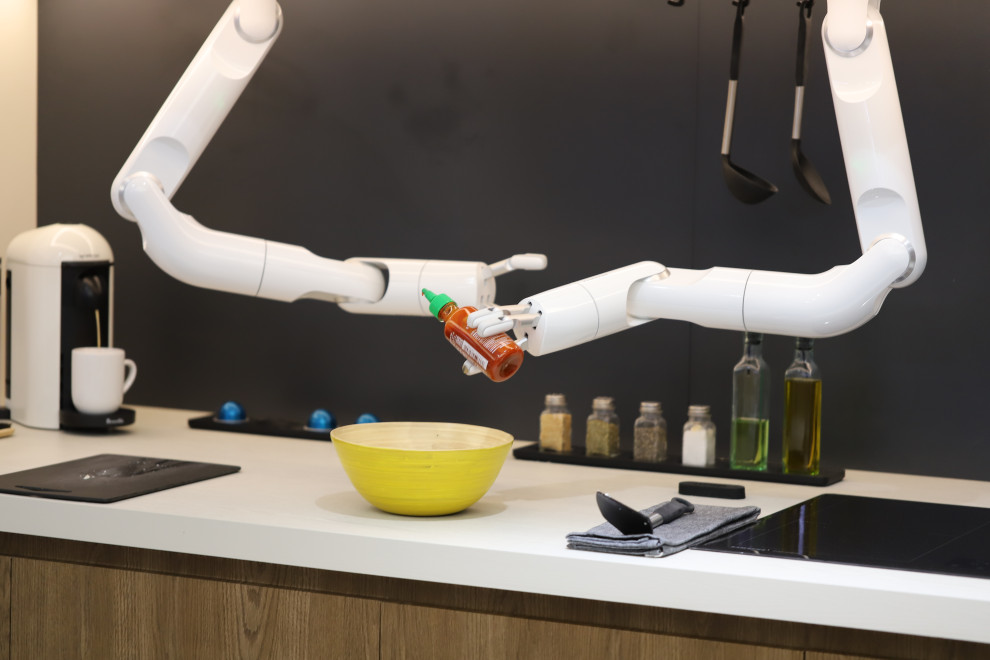
Samsung’s approach to robotics thus far appears to be the model of many other big electronics companies. It’s flirtation with a technology that brings some sense of showmanship to the stage and booth. There’s no better example than Bot Chef. I got a preview of the tech in Samsung’s booth this week, pitched as “an extra set of hands in the kitchen.”
You can’t fault the technology for not being ready for prime time, at this point, of course. That’s not really the point yet. The question, however, is how serious Samsung is about bringing a pair of robot arms to kitchens across the globe to sauté tofu and liberally apply Sriracha. I would love to say “very,” and that the different demos were things the company was actively pursuing delivering on these products.
The futuristic theme of last night’s keynote, however, implied that the company is offering up hypotheticals for what a future could look like — not what it will. Even Ballie, which seems a more realistic addition to the company’s smart home strategy is also still very much conceptual. As with last year’s robot demos, I wasn’t able to get an answer from the company about how much of the robot’s functions were autonomous and how much were choreographed. It’s a cool demo regardless. But is it a serious one?
At the end of the day, I hope Samsung is getting serious about the category. The company has tremendous resources and a lot of smart people. If it really takes the leap, it could be a key player in making robotics more mainstream among consumers. For now, however, I’m unconvinced.
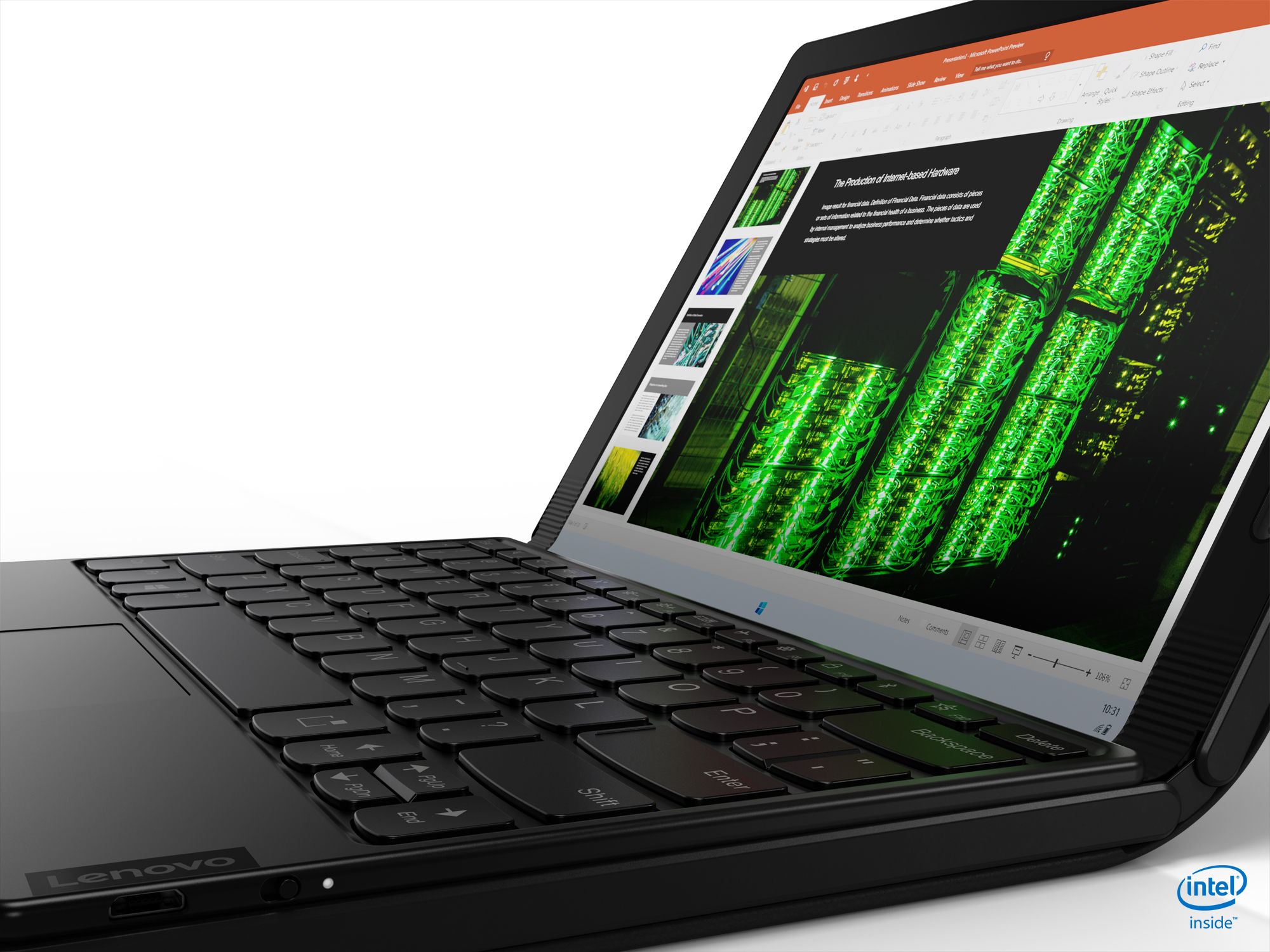
I know, I know. Laptops fold. Convertibles fold. I get it, you’re being pedantic. So let’s just move past all of that and talk about this funky new thing from Lenovo. The company just announced the ThinkPad X1 Fold — the delivery of the device it teased back in May of last year.
The product is probably best described as the lovechild of a foldable phone and a laptop. You’ve got to hand it to Lenovo — while it’s true not every device is a runaway success, the company is more than happy to experiment with interesting concepts in between more straight-laced office-minded offerings.
More than anything, the X1 Fold is the latest in a long line of convertible form factors attempting to bring the best of tablets and laptops to a single form factor. Maybe there’s a seed of an idea here. We’ll see the thing in person, soon, but if early foldable phones are any indication, it could be a bit rough going at first. That said, Lenovo’s new Motorola Razr might be the closest of all to sticking the landing.
The laptop has a 13.3-inch display when unfolded, making it fairly compact. There’s also a magnetic Bluetooth keyboard that can sit on the bottom half of the screen for a full laptop effect, or be detached to be used with the fully unfolded screen (the $24 stand is not included). When the system’s not in use, it sits in the middle, charging wirelessly. I’m not sure how practical any of this is until I get a chance to try it out, but honestly, it’s pretty cool.
The screen is pOLED, manufactured by LG. Lenovo says the durability tests have been “extensive,” though if past is prologue, sometimes some real-world testing is required to really put a system through its paces. The folding mechanism is reinforced with a carbon fiber plate.
The Fold is expected to drop at some point in the middle of the year, priced at around $2,499, with Windows 10. There’s a Windows 10X version that will be available down the road, as well.
Pumping gas is not that difficult, but Amazon thinks the process could be even easier by way of a voice command, spoken aloud when you arrive at the pump: “Alexa, pay for gas.” Today, Amazon, alongside ExxonMobil and Fiserv, announced a new voice experience for pumping gas that will roll out to over 11,500 Exxon and Mobile gas stations across the U.S. later this year.
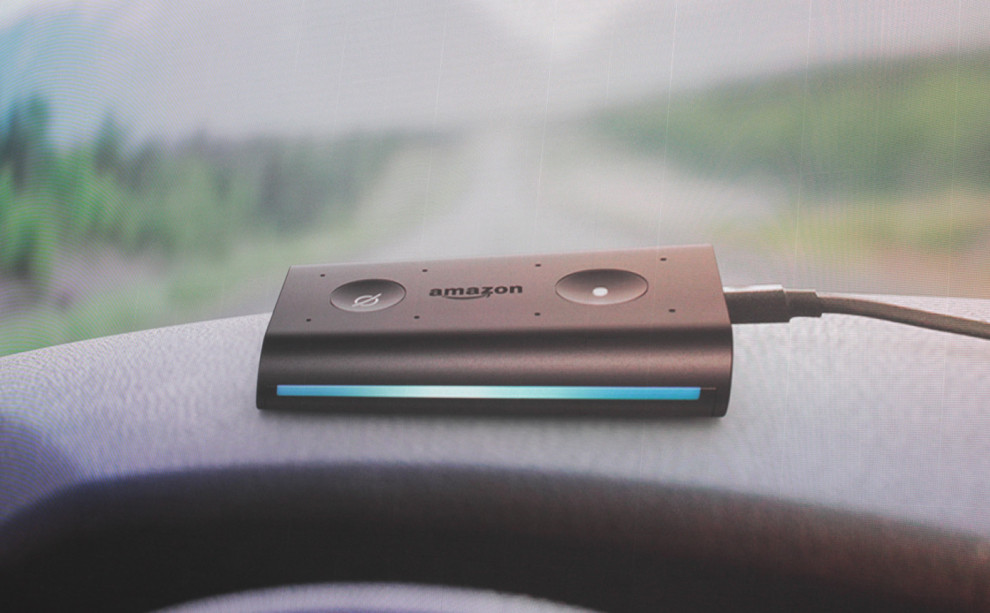
The ability to pay for gas via Alexa will initially be made available to customers with Alexa-enabled vehicles, Echo Auto, and other Alexa-enabled mobility devices, Amazon says.
When the customer arrives at the pump, they’ll just have to say, “Alexa pay for gas” to get started. Alexa will then confirm the station location and pump number.
The transactions themselves will be processed using Amazon Pay. That uses the same payment information stored in the customer’s Amazon account. Fiserv’s digital commerce technology will help to power the transactions by activating the pump and facilitating the token generation to ensure a secure payment experience.
https://youtu.be/WGy_ittIhBw
It’s not clear that the Alexa-enabled experience is significantly faster or easier than inserting your payment card at the pump directly. If anything, it seems a little more involved. But the technology could be useful for some because it allows you to remain in the car until the pump is authorized and ready to go, instead of requiring you to stand outside while the activation process takes place.
That’s a nice perk for cold, winter days — but it could also be appreciated by women and others who are wary of being alone at the pump — like when pumping gas at night or in unfamiliar surroundings, for example, or anywhere they don’t feel comfortable.
“We’re excited to bring new technology and better experiences to the gas station,” said Eric Carmichael, Americas fuels marketing manager at ExxonMobil, in a statement. “We build and seek out technology that will wow our consumers, providing both ease of use and security.”
Internal medicine doctor Tom Lee founded the startup, now valued at well-over $1 billion dollars, in 2007. Lee exited his company in 2017, leaving it in the hands of former UnitedHealth group executive Amir Rubin.
The startup currently operates 72 health clinics in nine major cities throughout the U.S., with three more markets expected to open in 2020 and has raised just over $500 in venture capital from it’s biggest investor, the Carlyle Group (which owns just over a quarter of shares), Alphabet’s GV, J.P. Morgan and others. Google also incorporates One Medical into its campuses and accounts for about 10% of the company revenue, according to the SEC filing. The filing also mentions the company, which is officially incorporated as 1Life Healthcare Inc. ONEM, now plans to raise about $100 million.
Presumably, this money will help the company improve upon its technology and expand to more markets. We’ve reached out to One Medical for more and so far have only been referred to its wire statement.
According to that statement, One Medical has applied for a listing as ticker symbol, ONEM under its common stock on the Nasdaq Global Select Market. We’ll be sure to update you if and when we hear more.
Image Credits: Costfoto / Barcroft Media / Getty Images
According to newly released third-party data, TikTok has reason to dance.
The famous, short-video application saw its in-app purchase revenue rise 310% on a year-over-year basis according to Apptopia, a startup that tracks mobile app revenue and usage. (The Boston-based startup has raised $8.2 million to date and competes with AppAnnie.)
TikTok’s revenue gains are impressive in more than percentage terms. The popular social application’s in-app revenue is now at a material scale — topping $50 million according to a chart published by Apptopia’s Adam Blacker. And while the company’s year-over-year growth is rapid, its sequential gain from a Q3 in-app top line figure of around $20 million may be even more eye-popping.
At $50 million a quarter, TikTok could generate hundreds of millions in yearly revenue — enough to go public on its own. And likely enough to provide material assistance to its parent company, ByteDance.
ByteDance, a China-based technology company worth well-north of $70 billion, is known for its Toutiao social media service as well as TikTok. TikTok was formed out of the fusion of Musical.ly, which ByteDance bought in late 2017, and and its own application Douyin. The app is an unquestionable breakout success around the world.
Tensions between the United States and China have risen in recent years, partially driven by the Trump administration’s stance regarding trade, and have spilled over into the technology industry — where the two countries had been inextricably linked.
Huawei and ByteDance are not the only Chinese companies caught — fairly or not — in the crossfire, but they are the among the best-known entities currently constrained by cross-Atlantic rancor.
ByteDance is an incredibly valuable company, at least according to its investors. The company is valued at nearly $80 billion as TechCrunch reported in 2018. It is considered an IPO candidate for 2020. Perhaps TikTok’s explosive growth in in-app revenue will help it file with the SEC.
If you know nothing else about particle accelerators, you probably know that they’re big — sometimes miles long. But a new approach from Stanford researchers has led to an accelerator shorter from end to end than a human hair is wide.
The general idea behind particle accelerators is that they’re a long line of radiation emitters that smack the target particle with radiation at the exact right time to propel it forward a little faster than before. The problem is that depending on the radiation you use and the speed and resultant energy you want to produce, these things can get real big, real fast.
That also limits their applications; You can’t exactly put a particle accelerator in your lab or clinic if they’re half a kilometer long and take megawatts to run. Something smaller could be useful, even if it was nowhere near those power levels — and that’s what these Stanford scientists set out to make.
“We want to miniaturize accelerator technology in a way that makes it a more accessible research tool,” explained project lead Jelena Vuckovic in a Stanford news release.
But this wasn’t designed like a traditional particle accelerator like the Large Hadron Collider or one at collaborator SLAC’s National Accelerator Laboratory. Instead of engineering it from the bottom up, they fed their requirements to an “inverse design algorithm” that produced the kind of energy pattern they needed from the infrared radiation emitters they wanted to use.
That’s partly because infrared radiation has a much shorter wavelength than something like microwaves, meaning the mechanisms themselves can be made much smaller — perhaps too small to adequately design the ordinary way.
The algorithm’s solution to the team’s requirements led to an unusual structure that looks more like a Rorschach test than a particle accelerator. But these blobs and channels are precisely contoured to guide infrared laser light pulse in such a way that they push electrons along the center up to a significant proportion of the speed of light.
The resulting “accelerator on a chip” is only a few dozen microns across, making it comfortably smaller than a human hair and more than possible to stack a few on the head of a pin. A couple thousand of them, really.
And it will take a couple thousand to get the electrons up to the energy levels needed to be useful — but don’t worry, that’s all part of the plan. The chips are fully integrated but can be put in series easily to create longer assemblies that produce larger powers.
These won’t be rivaling macro-size accelerators like SLAC’s or the Large Hadron Collider, but they could be much more useful for research and clinical applications where planet-destroying power levels aren’t required. For instance, a chip-sized electron accelerator might be able to direct radiation into a tumor surgically rather than through the skin.
2019 was a breakout year for the podcast industry with major shifts in industry dynamics.
In my October 2018 post “What’s next for podcasting?” I argued that Hollywood’s surging interest in podcasts would bring greater investment in high-production quality shows and gradually realign the podcast industry around paid subscriptions and exclusive deals.
That’s still the direction the industry is heading but it’s not happening overnight and it may look a little different than I initially expected. Here’s a review of the state of podcasting as we conclude 2019.
Corporates vs. entrepreneurs
It is clear that the major music streaming platforms will dominate podcast distribution as well. The crowded landscape of startup podcast streaming apps will fade into 3-5 top platforms, much the same as music streaming consolidated. The top music streaming platforms have the user base and resources to promote podcasts to mass audiences, and Spotify has shown people are fine with both music and spoken audio in the same app. As with songs and videos, the consumer experience with podcasts is defined by the content so minor feature differences between the apps distributing the content are not going to pull consumers away from the audio apps they already use.
This makes podcasting a tough market for VC investment; the incumbents are capturing the big tech platform opportunities and likely to own most of the advertising, infrastructure, and analytics tools as well through a mix of internal product development and acquisitions. The best position for entrepreneurs to be in podcasting is either a bootstrapped startup whose tool set can get acquired for tens of millions of dollars or a production company creating popular content in this boom.
Spotify’s breakout performance
The most important player in the industry is now Spotify, even though Apple’s Podcasts app remains the largest by global and US market share. In just three years, Spotify went from not being a destination for podcasts to being the first or second most used podcast service across dozens of countries and most US states. 2019 was its breakout year.
Spotify redesigned its app to give podcasts nearly equal footing as songs and it bought two of the leading podcast production companies (Gimlet, Parcast) and one of the most popular production tools (Anchor), positioning it at the heart of the podcast ecosystem and fueling investment interest in the sector more broadly.
For Spotify, podcasts are a rapidly growing new category of content that’s still small enough that they as a $28 billion company could make a play to dominate. The company is battling to differentiate itself from Apple Music and other music streaming competitors who all have the same libraries of songs, and it’s battling to improve its gross margins. Since 70% of all money earned from music on Spotify must be shared with music rights holders, expansion beyond music can improve the company’s profitability. Its CEO Daniel Ek envisions over 20% of listening on Spotify to be non-music audio content within a few years.
Most importantly for the industry, Spotify is expanding the overall pie and pushing more podcasts into mainstream pop culture by promoting shows to demographics of music listeners who weren’t meaningfully engaged with podcasts before. The company is proactively recommending specific podcasts to users it predicts will like them and made a point to include podcasts in its popular year-end summaries of users’ listening habits.
Justine Moore and Olivia Moore at VC firm CRV summarized the diversification of podcast listening in their TechCrunch op-ed in August:
“As podcasting grows, the listener base is diversifying. Edison Research looked into data on “rookie” listeners (listening for six months or less) and “veteran” listeners (listening for 3+ years), and found significant demographic differences. Only 37% of veterans are female, compared to 53% of rookies. While the plurality of veterans (43%) are age 35-54, 54% of rookies are age 12-34. Rookies are also 1.6x more likely to say they most often listen to podcasts on Spotify, Pandora or SoundCloud (43% versus 27% of veterans).”
It will be surprising if Spotify doesn’t make multiple podcasting-related acquisitions in 2020. It may buy more studios to bolster its in-house production team and its library of in-demand content that could eventually be made exclusive to the platform, but the primary acquisition targets are likely to be on the technology side. Tech solutions it may want are a programmatic advertising network for podcast ads, natural language processing tools that make podcast audio more easily searchable, and a flexible solution for media companies with subscriber-only podcasts to still have those podcasts available on Spotify. Fellow Stockholm-based company Acast seems like a natural, though still bold, potential target here.
Manage Consent
To provide the best experiences, we use technologies like cookies to store and/or access device information. Consenting to these technologies will allow us to process data such as browsing behavior or unique IDs on this site. Not consenting or withdrawing consent, may adversely affect certain features and functions.
Functional
Always active
The technical storage or access is strictly necessary for the legitimate purpose of enabling the use of a specific service explicitly requested by the subscriber or user, or for the sole purpose of carrying out the transmission of a communication over an electronic communications network.
Preferences
The technical storage or access is necessary for the legitimate purpose of storing preferences that are not requested by the subscriber or user.
Statistics
The technical storage or access that is used exclusively for statistical purposes.The technical storage or access that is used exclusively for anonymous statistical purposes. Without a subpoena, voluntary compliance on the part of your Internet Service Provider, or additional records from a third party, information stored or retrieved for this purpose alone cannot usually be used to identify you.
Marketing
The technical storage or access is required to create user profiles to send advertising, or to track the user on a website or across several websites for similar marketing purposes.