Categories
Technology Uncategorized

Why ASML’s 20% Drop Is a Golden Buying Opportunity

ASML, the Dutch behemoth of semiconductor equipment, has seen its stock price plunge amid a broader tech selloff and growing geopolitical tensions. While the company’s unparalleled dominance in extreme ultraviolet (EUV) lithography technology positions it as a cornerstone of the semiconductor industry, investors are grappling with the challenges posed by a potential slowdown in chip demand, escalating trade restrictions, and the looming specter of technological obsolescence.

ASML’s stock price has retreated by over 20% from its recent peak, mirroring a broader market downturn that has disproportionately impacted technology companies. The company’s exposure to the semiconductor sector, a bellwether for broader economic health, has exacerbated its vulnerability to market volatility. Moreover, the specter of heightened trade restrictions between the United States and China, a critical market for ASML, has cast a shadow over the company’s growth prospects.

At the heart of ASML’s value proposition is its monopoly on EUV lithography, an indispensable technology for producing the most advanced chips. These machines, capable of etching intricate patterns onto silicon wafers with unprecedented precision, are essential for the continued miniaturization of semiconductors, a trend that has been the driving force behind the tech industry’s relentless innovation.

However, ASML’s dominance is not without its challenges. The company faces the daunting task of sustaining its technological leadership in an industry characterized by rapid innovation and fierce competition. Additionally, the potential for geopolitical tensions to escalate could disrupt supply chains and access to critical markets.

Despite these headwinds, ASML’s long-term prospects remain compelling. The semiconductor industry, driven by the insatiable demand for computing power, is expected to experience robust growth over the next decade. As the sole supplier of EUV lithography equipment, ASML is well-positioned to capitalize on this growth.

Moreover, the company’s valuation, while still elevated, has become more attractive following the recent decline in its stock price. For investors with a long-term horizon, ASML presents an opportunity to acquire shares of a dominant player in a critical industry at a potentially discounted valuation.

However, caution is warranted. The semiconductor industry is cyclical, and periods of oversupply and weak demand can lead to significant stock price declines. Additionally, the escalating geopolitical tensions between the United States and China could pose a material risk to ASML’s business.

Investors should carefully consider the risks and rewards before investing in ASML. While the company’s long-term prospects remain promising, the near-term outlook is clouded by uncertainty.

Categories
Uncategorized

Shifting Sands: Potential New Entrants Poised to Reshape the S&P 500 in Upcoming Rebalance

The S&P 500 is on the cusp of its quarterly reshuffling, and Wall Street analysts have pinpointed several stocks that might secure a spot in this prestigious index next month. Gaining entry into the S&P 500 not only elevates a company’s stature but also typically bestows considerable financial benefits. According to Barclays analyst Ramsey El-Assal, stocks newly added to the index have historically enjoyed an average first-day trading bump of 7.7%. The most recent additions were Super Micro Computer and Deckers Outdoor, which took the places of Whirlpool and Zions Bancorporation, respectively, in March.

One of the main contenders for inclusion this time around is Block, the payments company that achieved eligibility following its positive net income report in the fourth quarter of 2023. While not a guaranteed selection, Block presents a compelling case, particularly due to the current underrepresentation of financial services within the S&P 500. El-Assal notes, “Financial Services is the second most underweight industry category in the index, after Software & Services. Given Block’s $45 billion market cap, it stands out as a prime candidate for inclusion.” Additionally, potential mergers and acquisitions involving current index members could further open doors for Block’s entry.

Despite a challenging year where Block’s shares have declined by about 8%, the upside remains substantial, with Barclays setting a $100 price target for the stock, indicating a nearly 40% potential increase from the current levels. The firm maintains an overweight rating on the shares.

Keefe, Bruyette & Woods echoes the sentiment regarding financial services stocks, suggesting both Square and Coinbase as potential “wild card” entrants due to their recent qualifications. Among the names, Dell is seen as the most likely new entrant because of its substantial size. Other firms like KKR and Apollo Global Management, while considered, are deemed less likely to be included.

Analyst Shreyank Gandhi from Keefe, Bruyette & Woods also anticipates changes beyond the S&P 500. He predicts that Ryan Specialty Holdings could move up to the S&P Midcap 400, while New York Community Bancorp might be shifted to the S&P SmallCap 600. Additionally, Axis Capital Holdings and BOK Financial are tagged as potential newcomers to the SmallCap 600 index.

As Wall Street prepares for these adjustments, the S&P 500 rebalance will officially take effect after the market closes on June 21, with the forthcoming changes slated to be announced on June 7.

The anticipation of these index rebalances underscores the dynamic nature of market indices, reflecting broader economic shifts and individual corporate performances. For investors, these adjustments offer strategic insights into potential value adjustments and market perceptions, signaling both opportunities and shifts in the investment landscape. As companies like Block navigate towards potential inclusion, their evolving financial narratives play a crucial role in reshaping market indices and, by extension, investment portfolios across the globe.

Categories
Uncategorized

Is Now the Perfect Time to Invest in These Undervalued Blue-Chip Stocks?

Minting substantial returns from the market often hinges on the strategic selection of stocks, coupled with patience and a keen eye for undervalued opportunities. This analysis delves into the realm of blue-chip stocks that have not seen significant movement in recent times but are on the brink of potentially robust growth. Despite their current stagnation, these stocks exhibit traits of undervaluation, making them ripe for investment. With the anticipation of business and growth catalysts on the horizon, these companies are expected to perform exceedingly well, surpassing index returns in the forthcoming 24 months.

Lockheed Martin (NYSE:LMT) has experienced a 7% decrease over the past year, yet it has shown a commendable 48% return over the past five years. Currently, it appears undervalued with a forward price-earnings ratio of 16.8 and an enticing dividend yield of 2.88%. The bullish outlook for Lockheed Martin is fueled by the global uptick in defense spending, which reached a new zenith of $2.2 trillion in 2023. With NATO members ramping up their defense budgets, Lockheed Martin stands to gain significantly. The company’s record backlog of $160.6 billion at the end of 2023 positions it for accelerated revenue growth, potentially driving its stock price upwards. Additionally, Lockheed Martin’s commitment to free cash flow, projected at $6.2 billion for the year, promises ongoing shareholder value through dividends and share buybacks.

AstraZeneca (NASDAQ:AZN), another contender in the stagnating blue-chip arena, is undervalued at a forward price-earnings ratio of 15.7, with a dividend yield of 2.2%. The post-pandemic world has overlooked biopharmaceutical stocks, yet AstraZeneca’s diversified drug portfolio addresses a broad spectrum of global health issues. With 178 projects in its pipeline and 17 late-stage molecular entities, the company is on the verge of breakthroughs that could significantly boost revenue in the near future. AstraZeneca’s 35% year-on-year growth in emerging markets (excluding China) in 2023 underscores its global diversification and potential for sustained growth.

Occidental Petroleum (NYSE:OXY) has seen a 9% increase in stock price over the last year, attributed to recent gains. With an undervaluation and a dividend yield of 1.37%, Occidental is poised for further appreciation. The recent surge in oil prices to an 11-month high, alongside continued OPEC production cuts and geopolitical tensions, suggests a favorable outlook for Occidental. The company’s investment-grade balance sheet and a reported $5.5 billion in free cash flow last year provide a solid foundation for dividend growth, share repurchases, and exploration investments. Endorsed by Warren Buffett, Occidental Petroleum is set to create significant value for investors in the near term.

Conclusion:

The detailed examination of Lockheed Martin, AstraZeneca, and Occidental Petroleum highlights their potential to break out of stagnation and achieve substantial growth. These undervalued blue-chip stocks, backed by solid business fundamentals and poised for upcoming positive catalysts, present compelling opportunities for investors seeking to diversify their portfolios and harness exceptional returns. With strategic investments in these companies, investors can look forward to reaping the benefits of their resurgence and market outperformance in the next couple of years.

Categories
Other News Uncategorized

A Trading Strategy that Covers Your Living Expenses

The cost of living is expensive.  Think back 20 or so years and see if you can remember what you thought it would cost to send your kids to college, or what the price of groceries would be.  Are your utilities higher?  Between currency devaluation and inflation, things cost much more now than what we expected.

I remember beginning to save for my kids’ education and thought that on the high end I’d need about $30k per child (I have 3).  My first child cost $80k, second $60k, and the third is just starting; a bit of a short fall.  Back in 1990, my out of state tuition for graduate school was $1800 per semester.  Under graduate in state tuition is about $4500 per semester now.  How do we make up for that?  You work, you save, and you still can’t make ends meet.  It gets to be frustrating.  But, I am a trader of markets, and I have figured out how to cushion the blow.

I told you earlier that my first child cost $80k to go to college.  He graduated high school in 2007.  The dollar was weakening and I put the “college fund” into foreign currencies.  By the end of 2009, I had paid for his tuition with currency conversion only (and interest since these were currency CD’s).  I maintained the $100k I started with and used the proceeds of currency conversion to pay his expenses.  I found a needle in a hay stack that made the short fall I was going to have almost a non-issue.

Many things I trade these days are not necessarily to make money, it is to pay for the things I buy or need to buy.  I trade live cattle futures to pay for the meat on the table, and coffee for that cup of joe each day.  Cotton for the clothes I wear, and some stocks because I bought stuff there and want my money back.  I have found that the market is a great way of financing the many things I do and need.  You can do it too.

Nobody likes to pay for utilities, but they are necessary.  To help pay for the utilities, trading bond futures options seem to work well.  Let’s discuss bond futures and their options a bit before we get to trading them.


[PDF] Options Trading Strategies Guide

This FREE strategy guide breaks down 11 specific options methods for a total game plan in any market condition!

Download it Now


Bond futures are a commodity that trades in 1/32 increments and are worth $1000 per point and $31.25 per tick (1000/32 = 31.25).  It controls a $100,000, 30 year US treasury bond.  It is traded by the bond price, not the interest rate of the bond, though, it is interest rate sensitive.  So, if interest rates go higher, bond price goes lower, and if interest rates go lower, bond prices go higher.  This is because of supply and demand.

Think about this, if I owned a bond with an interest rate of 5% and currently interest rates are at 2%, how many people want my bond? Lots, because they can get a better return with my bond, and so, the price of that bond is more expensive compared to the current bond. And if you switch that around, if I own a bond at 2% and current rates are at 5%, who wants my bond now?  No one.  So as interest rates increase, bond prices go down, and as the decrease, bond prices go up.

Bonds open at 17:00 CT and close at 16:00 CT. The price is displayed in decimal form or with a dash; 147.23, or 147-23, and sometimes 147’23.  The 23 is in 32nd.  So, the price is 147 and 23/32.  If you multiply that by 1000, the bond is worth $147,718.75.  Par value is $100,000, so in this case you would be paying a $47,718.75 premium.  Economic news will affect bonds, as they look for inflationary (rising interest rates) or deflationary (falling interest rates) indications.

Options on bond futures trade in 64th increments.  They trade as long as the bond futures are open and trading, so you can actually get out of your trade in the middle of the night, if need be. They are still $1000 per point but since they are half of a bond future tick, then they trade $15.625 per tick.  The bond options are no different than equity options except the price per point/tick is different, and you are only controlling one bond futures contract, as opposed to 100 shares of stock.  Since all futures are traded on margin, you will not have to have so much money to control the option contract. You will also notice that the strike prices are every half point on the bond options (32/64).  You might want to write this down and go back through it a couple of times, but I believe we have enough to go on.

There are weekly options on the bonds.  Some platforms only offer the monthly options, so beware of that.  We are looking for income, so we will be selling the options to bring in premium.  We want the option to deteriorate over the time of the option.  So, if we sell a bond option at 16 (16/64) we will bring in $250.  If we buy back the option at 5 (5/64), we pay $78.125 for it.  The difference is the profit, 250-78.125 = $171.875.  If we do this 2 to 3 times per month, this will generate $400 – $500 per month, per contract, to help pay the utilities.

To set up the trade, first we don’t want to risk more than $300 per contract in any trade.  So, if we sell an option at 16, then if it doubles or goes 19 ticks against us, then we will get out of the trade.  If using weekly options, we will not be bringing in much premium, so we will look for something between 10 and 20 ticks on the options ($150 – $300), and look to get out between 0-5.  Next, we need to look at the trend of bonds.  Here is a daily chart on the bonds (USU17 September 2017, 30yr Treasury bond future):
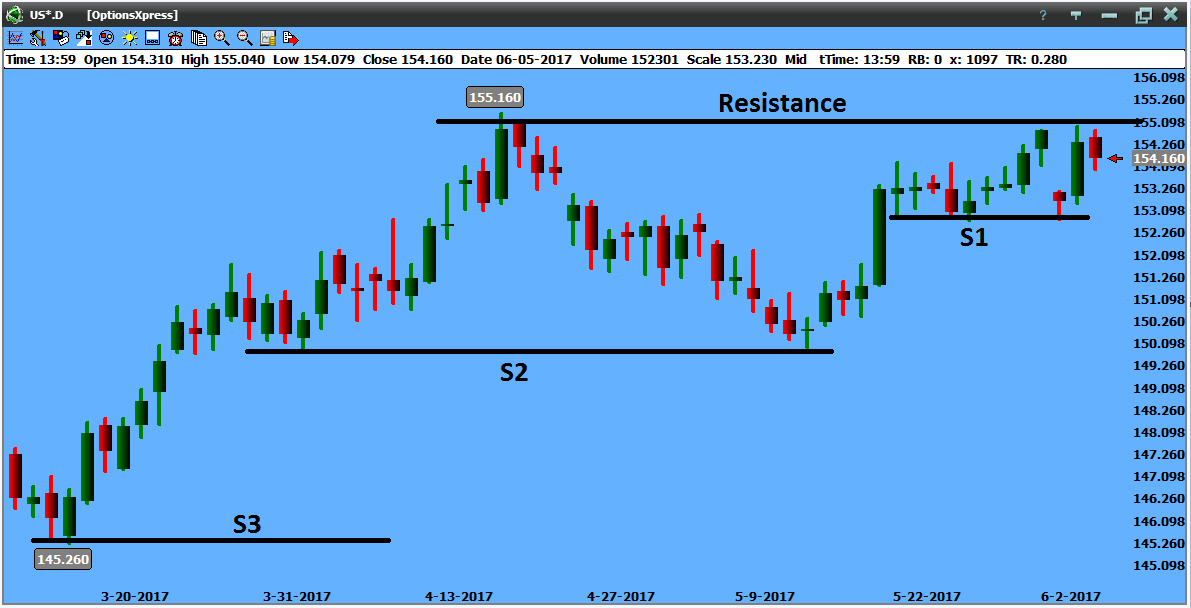
The S1, S2, and S3 are support points on the chart.  Notice bonds are in an uptrend.  So, selling put options will be the safest play since bonds will have a tendency to go up.  We will try to sell options at the support points.  Of course, the closest support point will bring in the most premium (S1) and the furthest support point (S3) will bring in the least premium unless we go out further in time.  If your platform only does monthly options, then I’d use the S3 point, but if using weekly options, use S1 or S2.  Another thing to keep in mind, find out when the big economic news is coming out since bonds will react to it.

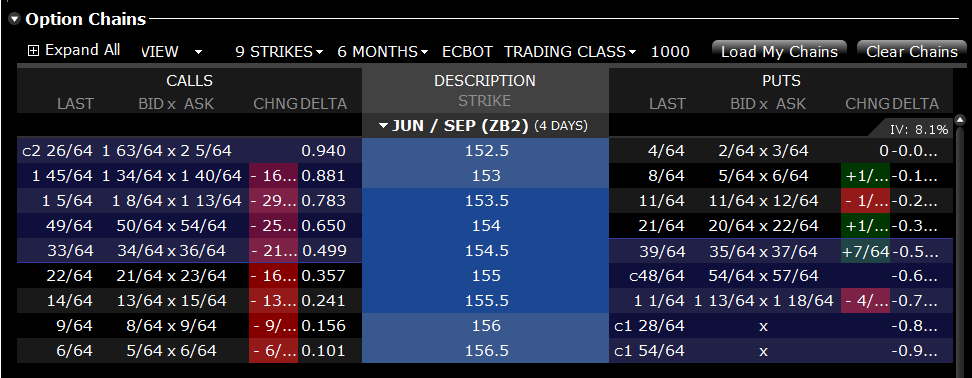
Look at the option chain below. Our S1 is around the 153 strike.  The Jun 9 Put option is trading at 8/64.  The 153.5 is at 11/64.  The 153 is around the S1 on the chart and bonds will have to decline another point and a half to get to that strike.  Let’s do the 153 strike.  The current bid and offer are 11/64 – 12/64.

If we put an order to sell at 12/64 and get filled, we will bring in about $187.50.  If today is Jun 5th and bonds are trading at 154-15, we will have to wait 4 days for the option to expire.  As long as the bond futures stay above 143-00 then the option will lose value each day.  If there is a big economic news day this week, we will need to either get out and take the profit we have, or be ready to exit if the bonds drop off because of the news.
For this trade, you will have to have a futures account with about $5000 in it.  If you don’t have a futures account, another way of looking at this trade is by using TLT (20 yr. Treasury bond ETF).  It too has weekly options, but selling naked puts may “cost” a little more since you will have to hold the put overnight and have a 50% margin on the value of the ETF.  So, the question will arise, can you do a put spread?  Yes.  However, you want to do this is just fine.  With the spreads, you may have to do multiple contracts to make up for the less premium being brought in, but they will work fine.

Doing this trade a couple of times a month can cushion the blow of the bills that come once a month.  We can’t win them all, but remember, we will not risk anymore than $300 per contract.  So, one loss will scratch one win for the most part.  If you have never traded options on bonds, paper trade it for a couple of weeks to see how it goes.  Once you get the hang of it, start paying some bills.  Good luck trading.

THE SPECIAL OFFER

Sign up below to get a chapter of Tom Busby’s new best-selling eBook emailed to you daily!

Sign up Here to Receive Tom Busby’s Best-Selling Book Here!

ABOUT THE AUTHOR

Geoffrey A. Smith

Author: Geoffrey Smith, CEO & Chief Instructor
Company: Diversified Trading institute
Website: DTItrader.com
Services Offered: Trading Education, Trade Alerts, Trade Rooms, Software
Markets Covered: Stocks, Options, Futures, Day Trading, Swing Trading

An active trader and investor for 25+ years, Geof focuses in futures, equities and option trading including trading commodity option futures. Geof took an instrumental role in developing the DTI Method. The Platinum Experience core level classes took first place in SFO Magazine and Trader Planet’s STAR awards in the best trading courses category.


Categories
Uncategorized

Why it’s [Almost] Always Best to Invest in the Dogs of the Dow

One of the greatest investment opportunities are the Dogs of the Dow.

And while some analysts may write off the Dogs of the Dow theory as antiquated, it’s just not true at all.  In 2011, there were up 16.3%. In 2012, they jumped 9.9%. In 2013, they returned 34.9%. In 2014, they returned nearly 11%.

In 2015, they did okay, returning just 2.6 %.

In 2016, the Dogs returned 16% on average. In 2017, the Dogs of the Dow returned 19% for the year.  And in 2018, the Dogs of the Dow lost 4% on the year, but still outperformed the Dow Jones’ overall 6% decline.

2020 was an ugly year for the Dogs of the Dow, which was down 13%. But historically, that’s the exception and not the rule.


[PDF] Options Trading Strategies Guide

This FREE strategy guide breaks down 11 specific options methods for a total game plan in any market condition!

Download it Now


Plus, we have to remember that each of the Dogs also pays a healthy dividend, too.

As for 2021, the Dogs are are yielding the following returns (Source: Nasdaq.com)

IBM (IBM) pays a 5.18% dividend

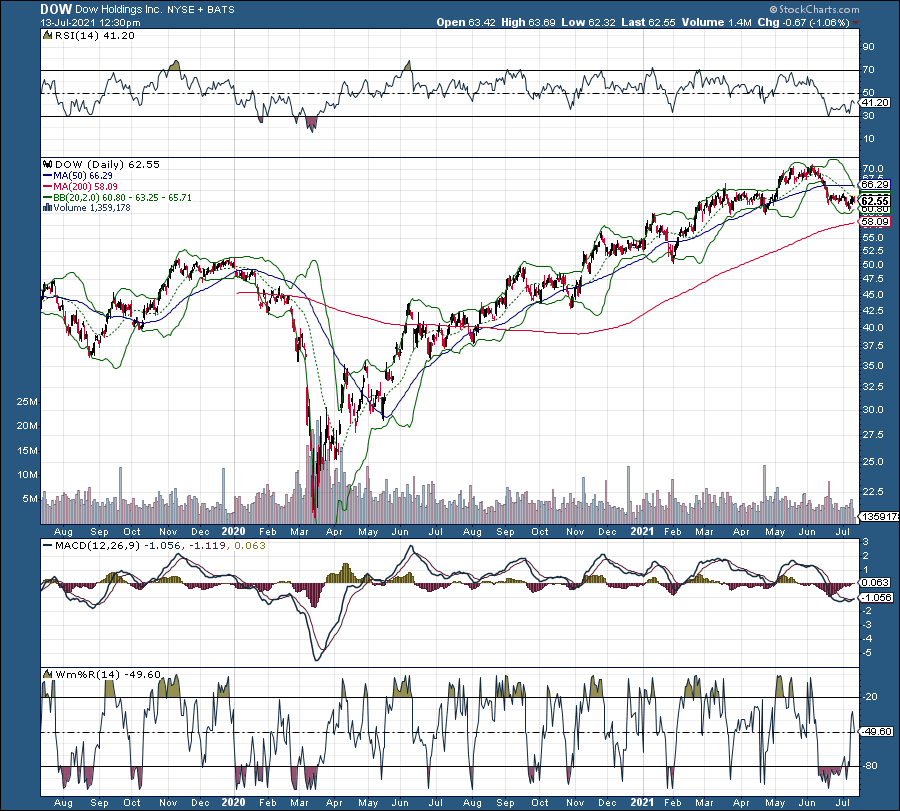
Dow, Inc. (DOW) pays a 5.04% dividend

Walgreens (WBA) pays a 4.69% dividend

Verizon (VZ) carries a dividend yield of 4.27%

3M (MMM) carries a dividend of 3.22%

Cisco Systems (CSCO) has a dividend yield of 3.22%

Merck (MRK) has a dividend of 3.18%

Amgen (AMGN) pays a 2.78% dividend

Coca Cola (KO) has a dividend yield of 2.99%

The best part – it’s a “set it and forget it” strategy.

You simply buy the 10 biggest Dow flops of the year that pay respectable dividends. You buy at the start of the New Year, and exit at the end of the year. Then, you simply repeat it. While others may say it’s an antiquated strategy with low success rates, history proves that wrong.

Even options can be used to trade the Dogs every year. You’d simply invest in a long-dated options dated out to December or January of the following year, set it, and forget it.

At this pace, the Dogs of the Dow could again outperform the overall market.